
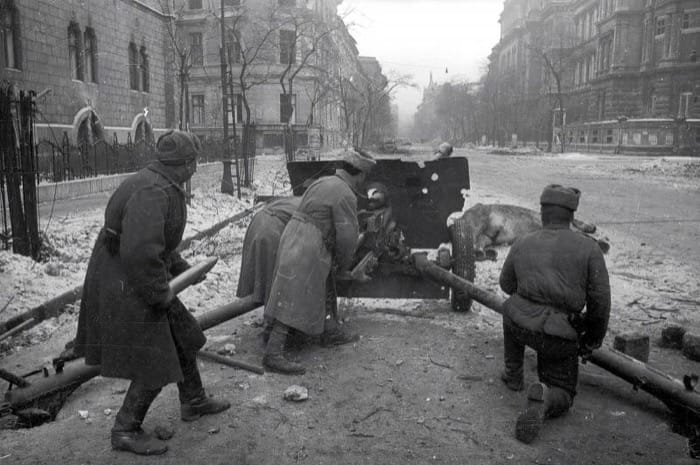
After enduring a brutal 50-day siege, Budapest finally surrendered to Soviet forces on Feb. 13, 1945. The ordeal began when Soviet and Romanian troops completed their encirclement of the city on Dec. 26, 1944, prompting Hungarian and German defenders to dig in and fight. The Hungarian capital, long celebrated as the "Pearl of the Danube," was left in ruins by the devastating offensive.
What no one realized at the time was that this battle would go down as one of World War II's most catastrophic urban engagements. Romania, once aligned with Germany, had switched allegiances during the Soviet Jassy-Kishinev offensive. Despite this setback, German and Hungarian forces managed to piece together a sufficiently large army to fight the Russians to a standstill near Debrecen, located in eastern Hungary.
Although Soviet troops had swept through much of Hungary at a rapid pace, their advance slowed considerably as they closed in on Budapest. For Hitler and the German military, the city held enormous strategic and symbolic value — not only as an outpost and trading town but as the capital of Germany's last remaining allied nation in Europe. Hitler believed that launching a powerful counteroffensive in Germany, combined with a firm Polish defense, could destabilize the Soviets and prevent them from massing their strength for an assault on Berlin.
Hitler wasn't alone in recognizing Budapest's significance. Josef Stalin viewed the Hungarian capital as a prize of immense political value. With the Allied Summit at Yalta only a few months away, he was convinced that quickly seizing both Budapest and Vienna would strengthen his hand at the negotiating table.
On Christmas Day, residents of Budapest learned that Soviet troops had reached the Budagyongye Train Depot. The siege officially began with small arms fire erupting near Janos Hospital. By the time the city offered its unconditional surrender on Feb. 13, 1945, the human toll was staggering. More than 38,000 civilians had perished — victims of military action, starvation, and mass executions of Jewish people.