
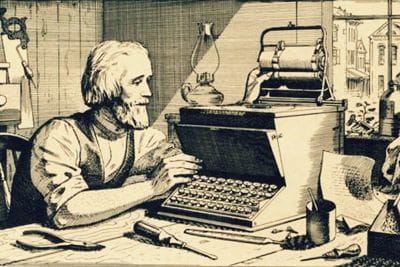
On January 7th, 1714, an English inventor named Henry Mill — who earned his living as a waterworks engineer — submitted a patent for a remarkable device. As described in the filing, it was intended "for impressing or transcribing of letters singly or progressively one after another, so neat and exact as not to be distinguished from print, very useful in settlements and public records."
The patent office of the day went ahead and accepted the proposal, but it was strikingly vague: no drawings accompanied it, no description of the actual apparatus was included, and there were zero instructions on how one might go about building the thing. Even so, most people regard it as the earliest known description of what would eventually become the typewriter. The big question that remains unanswered is whether Mill had a fully fleshed-out design rattling around in his head or was merely staking a claim in hopes of figuring out the specifics down the road.
Regardless of what Mill may have envisioned, the device itself never materialized. More than a century would pass before anything we'd recognize as a typewriter actually came into existence. That milestone arrived with the Sholes & Glidden Type Writer, which was initially designed in 1866 and ultimately manufactured and brought to market in 1874. Given this, a strong case can be made that the American inventor Christopher Latham Sholes and amateur mechanic Carlos S. Glidden deserve the title of fathers of the typewriter.
To be fair, a number of machines came before the Sholes & Glidden. Yet none of them could produce letters progressively and singly, as in writing — a capability that most typewriter history buffs consider essential to the very definition of the machine.
Still, it's hard not to feel that all of these later innovations owe at least a small debt to that patent filed on January 7th, 1714, by the English inventor Henry Mill.