
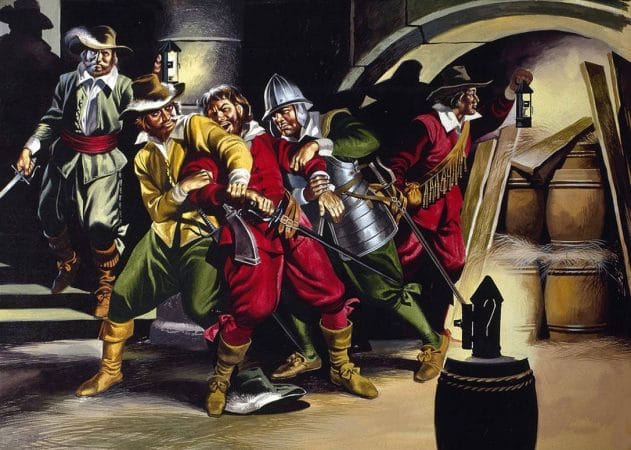
On November 5, 1605, a daring scheme to destroy King James I of England along with his entire Parliament went spectacularly wrong. The plan unraveled when Guy Fawkes was discovered at midnight on November 4, 1605, hiding in the cellars beneath Westminster with thirty-six barrels of gunpowder. His mission? To assassinate King James I and demolish the House of Lords during the opening of Parliament, scheduled for November 5, 1605.
The mastermind behind the conspiracy was Robert Catesby, who devised the plot as a response to the English government's relentless persecution of Roman Catholics. Under the agony of torture, Guy Fawkes eventually revealed his role in the English Catholic conspiracy — a scheme hatched by Catesby and fellow conspirators who dreamed of toppling England's Protestant government and replacing it with Catholic leadership.
After their capture and subsequent torture, Guy Fawkes and all of his co-conspirators faced trial and received death sentences for treason. The story took one final dramatic turn on January 31, 1606, when Fawkes, just moments before his scheduled execution, took his own life by leaping from a ladder as he ascended toward the gallows — the fall snapping his neck and killing him instantly.
In the aftermath of the failed Gunpowder Plot, the English government responded by enacting new legislation that stripped Catholics of their right to vote, along with other oppressive restrictions. Yet at the same time, in the year 1606, Parliament declared November 5 an official day of public thanksgiving.
To this day, every November 5, the British mark the occasion known as Guy Fawkes Night — also called Guy Fawkes Day and Bonfire Night — as a way of commemorating the Gunpowder Plot. As dusk settles across Great Britain, villagers and city dwellers alike gather to light bonfires, launch fireworks into the sky, and set ablaze effigies of Guy Fawkes.