
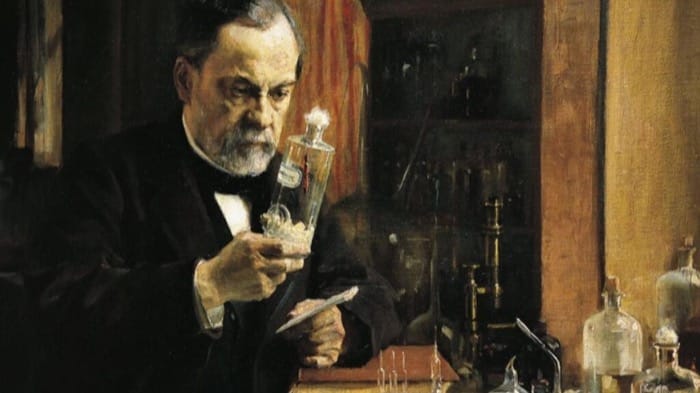
On July 6-1885, Louis Pasteur, the celebrated French chemist and bacteriologist, made medical history by administering the first anti-rabies vaccine to a nine-year-old boy. Young Joseph Meister became the first human being ever to be spared death from the deadly viral disease, thanks to Pasteur's groundbreaking anti-rabies inoculation on this remarkable day.
The way rabies spreads to humans is through the saliva of an infected animal, most commonly via a bite. In 1885, a rabid dog had viciously attacked young Meister, leaving him with severe bite wounds. His terrified mother, desperate for help, made her way to Paris in search of Pasteur. She didn't even know the identity of the man she was seeking — only that someone existed who might be able to prevent her son from dying of the virus.
Moved by the plight of the distraught mother and her young son, Pasteur began the treatment at the Hôtel-Dieu hospital, injecting Meister with an initial dose derived from the spinal tissue of a rabies-infected dead rabbit. To carry out the world's first human rabies vaccination, Pasteur brought in both a physician and a pediatrician to assist him. Over the course of 11 days, the boy received a grueling total of 13 inoculations.
What many don't realize is that Pasteur actually risked legal consequences by saving Meister's life — he wasn't a licensed physician at the time. Nevertheless, within three months of completing the treatment, Meister was declared completely healthy, all thanks to Pasteur's bold intervention. The unprecedented success of this revolutionary vaccine meant that no legal action was ever brought against him.
The method behind Pasteur's anti-rabies vaccine involved growing the virus inside rabbits, then weakening it by drying the infected nerve tissue from the animals. Each of Meister's 13 injections contained progressively stronger versions of the virus, weakened over shorter and shorter time frames.
Pasteur's achievement earned recognition from the French Academy of Sciences, and the vaccine's proven effectiveness opened the door to treating numerous additional rabies cases. Building on this triumph, Pasteur established his now-famous institute two years after unveiling the rabies vaccine to the world. As for Meister himself, he would go on to serve as a janitor at the Institute.
In the years since its founding, the Pasteur Institute has been responsible for developing numerous additional vaccines and has made substantial contributions to research on infectious diseases and their control.