
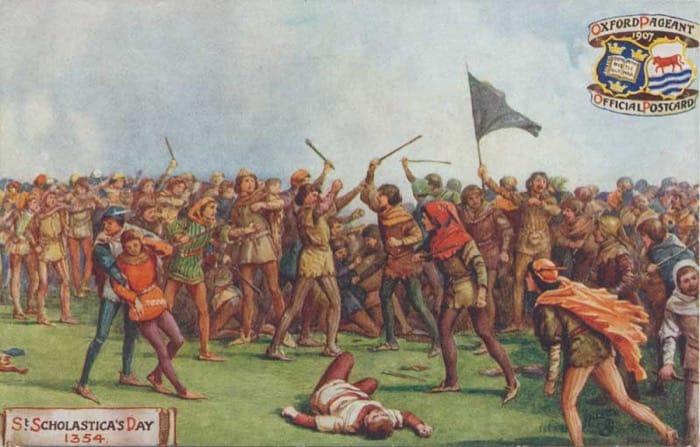
What began as a complaint about wine on Feb. 10, 1355, would spiral into one of medieval England's bloodiest town-versus-university clashes. It was the feast day of Saint Scholastica in Oxford, England, and two University of Oxford students drinking at the Swindlestock Tavern took issue with the quality of the wine. Words grew heated between them and the tavern owner, sparking a brawl — the latest flashpoint in a "town and gown" rivalry that had been simmering for centuries.
Patrons throughout the inn were soon swept up in the violence, which rapidly escalated into a full-blown riot. Townspeople rang the church bell to summon reinforcements, and the students answered by ringing the university church's bell. Even the Chancellor of the University couldn't restore order — when he attempted to intervene, the townspeople drove him back with a volley of arrows.
By the second day, roughly 2,000 men from the surrounding countryside had swelled the ranks of the townspeople, and the first student was killed. Over the course of that day and the one that followed, the mob slaughtered 64 scholars and clerics, while losing about 30 of their own. The violence finally subsided on the evening of the third day.
In the aftermath, King Edward III came down squarely on the University's side. He expanded the institution's authority, had the mayor and bailiffs thrown in prison, and levied a fine of 500 marks against the town. For one full year, all religious practices were banned — with the sole exception of baptisms of children. And for the next 470 years, on every St. Scholastica's Day, the mayor and bailiffs were compelled to attend a mass honoring the slain scholars and pay a fine of one penny for each of the 64 killed.