
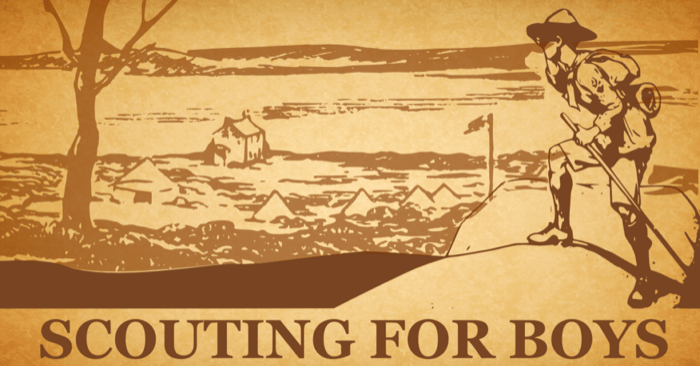
When Robert Baden-Powell sat down to pen Scouting For Boys, it's hard to imagine he foresaw just how far-reaching its impact would become. On Jan 24, 1908, Lieutenant General Robert Baden-Powell released the book to the public — a guide dedicated to outdoor skills and self-improvement.
What happened next took on a life of its own. The self-instruction manual flew off shelves almost immediately, igniting the Scout Movement across Britain. Of course, Robert was hardly an unknown figure before the book's release — he was already widely celebrated in the English community, and plenty of young men looked up to him as a model of achievement. That reputation meant English boys were eager to get their hands on a copy the moment it became available. By the time April finally rolled around, Scouting For Boys had evolved from a popular book into something much bigger: a full-fledged Boy Scout Troops movement.
About Baden Powell
What made Lieutenant General Robert Baden-Powell a British hero in the first place? His celebrated defense of Mafeking in South Africa, a grueling mission that stretched on for 217 days. During his military career, Powell authored a field manual for soldiers called Aids to Scouting — and, somewhat unexpectedly, it became a hit among young British readers as well. It wasn't long before Baden discovered that boys across the country were turning the field manual into games, using it to practice the very skills it described.
Inspired by this enthusiasm, Baden set out to create something new — a non-military manuscript tailored to young adolescents, with a focus on morality and good deeds. Soon after Jan 24, 1908, he gathered a group of 21 boys and led them on a camping expedition. During the experiment, the boys threw themselves into games designed to build skills in camping, woodcraft, observation, boating, deduction, and lifesaving.