
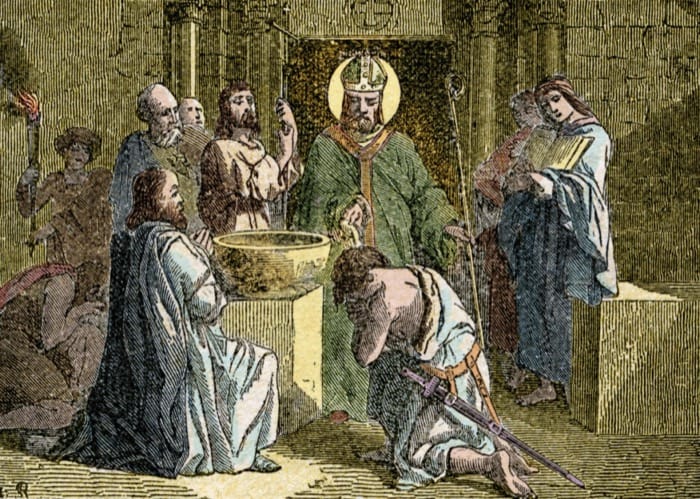
Living along Britain's western coast during the 5th century meant facing a harsh and perilous existence. A major source of that danger came from relentless Irish raids, during which livestock was stolen and people — men, women, and children alike — were seized and carried off into slavery. It was on one such raid, on March 17th, 432, that Irish pirates captured a 16-year-old boy and dragged him across the sea to Ireland. That boy would one day be known as Saint Patrick.
Of course, sainthood was far in his future at that point. Back then, he was simply Maewyn Succat, a young man from a prosperous Welsh family with deep roots in the Christian faith — something quite uncommon for the era. His grandfather had served as a priest, and his father, a deacon, also held a minor official position within the Roman Empire. Yet despite this religious upbringing, it was only through the ordeal of enslavement that he truly embraced Christian devotion.
Put to work tending sheep, the young captive came to view his suffering as a divine trial meant to strengthen his faith — and strengthen it, it did. He spent his days in constant prayer, and during this period, he experienced powerful visions of pagan Ireland crying out for his help. These visions planted a conviction deep within him: he would bring Christianity to the pagan Irish.
After managing to escape captivity six years later, he threw himself into pursuing that calling. He rose through the ranks of the Church, ultimately achieving the title of bishop. True to the vow he had made during his years of bondage, he returned to Ireland to spread the Christian faith. His tireless dedication to that mission earned him lasting recognition as Patrick, the patron saint of Ireland.