
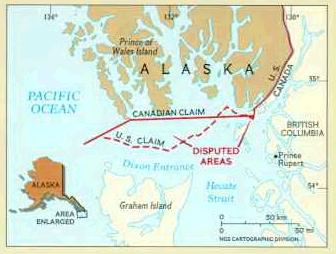
When Russia and Britain put pen to paper on February 22, 1825, they formally drew the line between Alaska and Canada. This agreement — commonly called the Anglo-Russian Convention of 1825 or the Treaty of Saint Petersburg — carved out the boundaries separating each nation's colonial holdings. Under its terms, Britain claimed ownership and control over the Pacific Northwest and Yukon territory, while Russia asserted its authority over the vast region then known as Russian America.
What exactly was Russian America? It encompassed most of present-day Alaska, along with several outposts in California and forts in Hawaii. Operating from 1799 to 1867, the colony initially sustained itself through the fur trade, but overhunting combined with a number of other issues gradually eroded its profitability. As settlements dwindled and were ultimately abandoned, the Russian Empire concluded it was time to walk away from its North American colonial venture. The result? In 1867, Russia offloaded the territory to the United States for $7.2 million — a sum that, adjusted for inflation, would be equivalent to $133 million today.
The territorial friction between Russia and Britain that the Anglo-Russian Convention of 1825 had attempted to settle didn't simply vanish — it flared up again after the United States took possession of Alaska through the Alaskan Purchase of 1867. It took until 1903 for the matter to finally be resolved through arbitration, and the outcome heavily favored U.S. interests at Canada's expense. The fallout was notable: many Canadians were left seething with a sense of anger and betrayal, though their frustration was directed not so much at the U.S. but primarily at Britain, which they felt had prioritized Anglo-American relations over Canadian interests.