
Afghanistan is often called the Graveyard of Empires, though this label is a considerable overstatement — the region was, after all, a core component of several highly prosperous empires throughout history. Still, when viewed through a western lens, three conflicts loom largest in shaping that narrative: the War in Afghanistan from 2001 to 2021, the Soviet-Afghan War from 1979 to 1989, and the First Anglo-Afghan War from 1839 to 1842.
The backdrop to the First Anglo-Afghan War was the Great Game — a prolonged rivalry between the British Empire and the Russian Empire over dominance in Central Asia and South Asia, spanning most of the 19th century and extending into the early 20th century. At the heart of British anxiety was the possibility that Russia might use Afghanistan as a gateway to invade British-controlled India. When Dost Mohammad Barakzai overthrew Shuja Shah Durrani and took power, those fears only deepened. Britain's attempts to influence Dost Mohammad Barakzai's foreign policy spectacularly backfired, pushing him to strengthen his ties with the Russians. The British response was to restore Shuja Shah Durrani to the throne.
At first, things went smoothly for the British. But it didn't take long for the situation to deteriorate, driven by several converging problems. The Afghan population deeply resented the foreign occupation. Shuja Shah Durrani proved to be an unpopular ruler — weak, cruel, and vindictive in the eyes of his own people. On top of all that, the British government cut off the subsidies it had been paying to local tribes, and predictably enough, those tribes abandoned any pretense of loyalty to the British-backed regime.
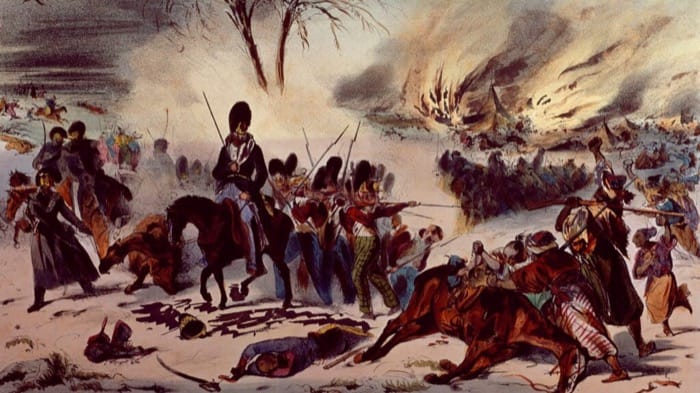
The inevitable uprising came when Kabul revolted. The British garrison found itself in an increasingly desperate position, and its commanders ultimately made the fateful choice to attempt a retreat to Jalalabad. What followed was catastrophic: of the 4,500 soldiers and 12,000 civilians who set out on that march, Dr. William Brydon is reputed to have been the sole person to reach their destination. The overwhelming majority of the others perished — cut down in combat or claimed by exposure and starvation along the way.
As for Dr. William Brydon, he barely survived the ordeal himself. Pursued nearly to the very walls of Jalalabad, he suffered a sword blow that took off a part of his skull.