
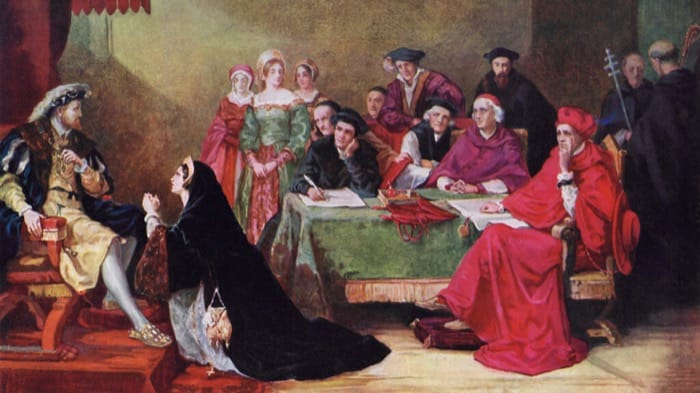
What started as a seemingly straightforward marital dissolution on March 7, 1530, would spiral into what many consider the most consequential divorce in all of history. For years, Henry VIII, king of England, had been wed to Catherine of Aragon, yet the union had produced no male heir. English custom demanded a son to succeed him, and Henry had grown convinced that Catherine would never bear him one. So he turned to the Pope, requesting a divorce. For a head of state like Henry, this was actually a fairly routine ask—the Church generally frowned upon divorce, sure, but exceptions were commonly made for rulers. Henry fully expected approval. What he got instead was a flat-out rejection.
Here's why: Catherine had previously been married to Henry's brother, meaning the union with Henry had required a papal dispensation in the first place. Unraveling that dispensation, the Pope feared, risked making the Church appear corrupt or at the very least incompetent. The recent schism with the Lutherans only deepened these anxieties, leaving the Pope especially sensitive about how the Church was perceived. Suffice it to say, Henry did not handle this rejection gracefully.
To put it mildly, he responded by breaking away from the Catholic Church entirely, declaring himself the head of the Church of England. With that authority in hand, he granted his own divorce from Catherine. The fallout was staggering—numerous people were executed in the process, and yet another schism tore through the Church. What followed were centuries of religious warfare and persecution across the British Isles. It's hard to think of any other divorce in history that unleashed such far-reaching and devastating consequences.