
Oliver Cromwell holds a truly unusual place in history — a man who received a dignified burial after dying of natural causes, only to be exhumed and subjected to execution for treason long after he was already in the ground.
How exactly does one execute a dead man?
Simple!
Cromwell stands as arguably the only classic dictator in the annals of English History. To those who fought alongside him, he was a brilliant military strategist who earned the title of England's protector for life. But the fundamental problem with this version of events is that it runs directly counter to the monarchy's narrative. For a brief stretch of years during the mid 17th century, England found itself governed by someone entirely outside the English line of procession. King Charles I was reduced to an ordinary man!
England's Civil War
The British Isles had, by the beginning of the 17th century, coalesced into Three Kingdoms — England, Scotland, and Ireland — each with its own ruling families. Although most of Europe had aligned with either Catholic or Protestant traditions, a growing number of people were embracing Enlightenment ideals such as self-rule through a parliament free from monarchical control. It was during the early 1640s that Cromwell rose to prominence as the leader of the Parliamentarians (called "Roundheads"), a faction determined to topple King Charles I. Their opponents on the battlefield were the Royalists (known as the "Cavaliers").
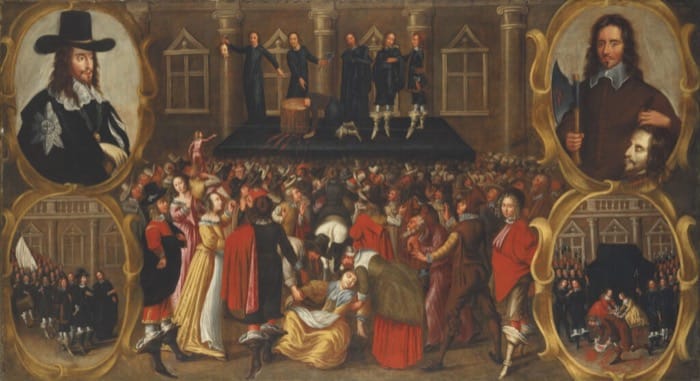
Cromwell and the Roundheads ultimately prevailed. A new government took shape to administer the Three Kingdoms under a single, united ruler — and that ruler was Cromwell. Under his Commonwealth of England, King Charles I was arrested and put to death.
Once the Royalists clawed their way back to power and Charles II claimed the throne, plenty of influential figures were eager to make an example of Cromwell — and they weren't about to let the minor detail of his being dead get in the way. A ritual execution was staged, ensuring that no one could mistake just how furious they were with the man.
His corpse was dug up, hung in chains, tossed into a pit, and then beheaded. The severed head was mounted on a pole at Westminster Hall, where it remained on grotesque display for the next 24 years. From there, it changed hands among a series of private collectors before ultimately finding a permanent resting place at Sidney Sussex College in Cambridge.