
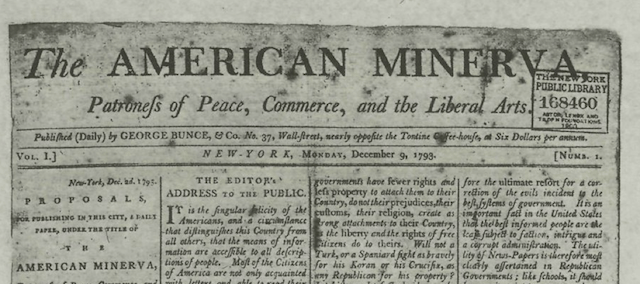
What many consider to be America's first daily newspaper rolled off the presses on December 9, 1793, when George Bunce & Co. produced the inaugural issue of American Minerva at 37 Wall Street in New York City, situated close to the Tontine Coffee House.
The debut edition featured a front page dominated almost entirely by a public address penned by Noah Webster, who served as both editor and publisher. Best remembered as the mind behind Webster's Dictionary — originally published in 1806 under the title A Compendious Dictionary of the English Language — Webster was driven by a commitment to keeping citizens educated and well-informed through news gathered from authentic sources.
Serving as New York City's first daily paper, American Minerva hit the streets every day of the week with the exception of Sunday. Under its complete title, American Minerva, Patroness of Peace, Commerce and the Liberal Arts, the publication ran for 744 issues spanning the years 1793 through 1796. A rebranding followed in 1797, when it took on the name Commercial Advertiser.
Noah Webster, a Connecticut Federalist who founded the paper, wore multiple hats as its editor while championing George Washington as the first United States president. The publication's Pro-Federalist stance also meant it actively worked to counter the spread of French influence in the United States of America. Convinced that Americans deserved access to political news more frequently than on a monthly basis, Webster remained at the helm as publisher of American Minerva until he stepped down in 1803.
Over the course of a remarkable 150-year run, the Newspaper passed through the hands of multiple owners and ultimately evolved into the New York Sun, which ceased publication in 1950.