
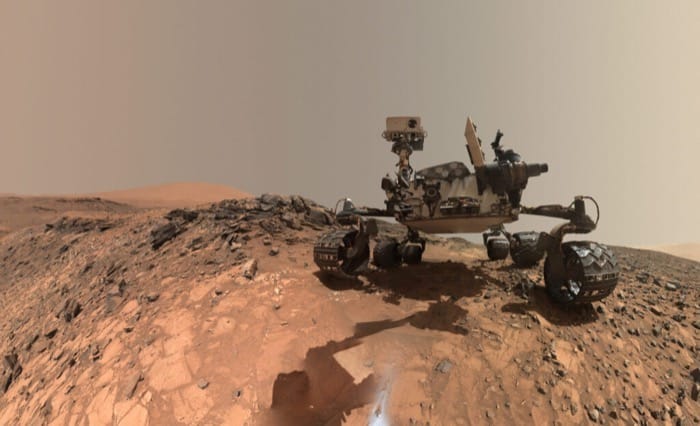
On this day in history, calcium deposits were found on Mars by NASA's Curiosity Rover — a breakthrough that carried enormous scientific weight. Why? Because it pointed to evidence of water on Mars, raising the tantalizing possibility that the planet was once habitable. Justin Maki, the engineering camera lead for the Mars Science Laboratory mission, shed more light on this historic finding in a Curiosity Rover report.
"The images being returned by Curiosity show a diverse collection of interesting features, including sedimentary rocks, pebbles, cracks, nodules, and veins," Maki reported.
Maki further detailed that the veins identified by NASA's rover showed traces of calcium sulfate. The mineral is suspected to exist in the form of either bassanite or gypsum.
Interestingly, as Maki and the NASA report pointed out, gypsum veins aren't unique to Mars — they occur here on earth as well. These veins take shape when water makes its way through cracks in rocks.
In the wake of this groundbreaking find, NASA revealed plans to drill into the veins.
The report noted that the location where the Curiosity Rover planned to carry out its first drilling activity sat near the rover's current position and featured a flat surface area perfectly suited for the task.
Launched from earth in November of 2011, NASA's Curiosity Rover touched down on Mars during the summer of 2012. Remarkably, as of 2021, the rover continues its exploration of the red planet. Tipping the scales at a hefty 1,982 pounds, the Curiosity Rover is roughly the size of a small SUV.