
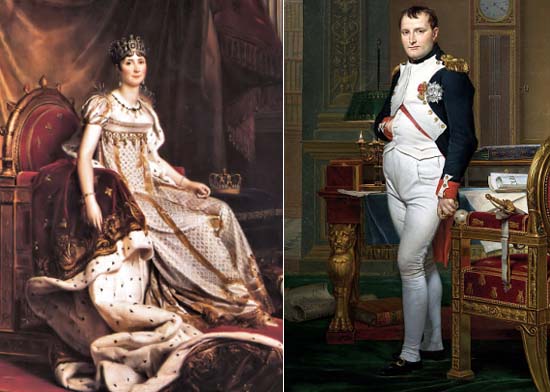
Napoleon Bonaparte walked down the aisle not once, but twice during his lifetime. His first marriage was to Josephine de Beauharnais, and his second to Marie-Louise of Austria. Yet it wasn't death that ended his first union — rather, a divorce finalized on January 10 of 1810 paved the way for him to wed the Habsburg-Lorraine princess.
By most accounts, Napoleon genuinely loved Josephine. She was an older widow who had served as mistress to several men before entering into a relationship with Napoleon himself. What's more, she already had two children from her previous life — a son, Eugene, and a daughter, Hortense. None of this sat well with Napoleon's family, and his mother and sisters in particular resented feeling unsophisticated by comparison.
Their marriage was far from smooth sailing on a personal level, too. Not long after they wed, Josephine took a lover, which in turn drove Napoleon to pursue extramarital affairs of his own. One of these liaisons nearly tore them apart shortly before their coronation as Emperor and Empress, and it took the intervention of Josephine's daughter Hortense to mend the rift.
In the end, though, it was the couple's inability to produce an heir together that proved fatal to the marriage. The decisive moment arrived in 1807 when Napoleon Charles Bonaparte — Napoleon's nephew and Josephine's grandson, who had been designated as Napoleon's heir — died of croup. This loss set the Emperor on a search for a younger wife who could bear him children. He and Josephine divorced on January 10 of 1810, and just two months later, on March 11 of 1810, Napoleon married Marie-Louise of Austria by proxy.
Despite everything, the former spouses appear to have parted on amicable terms. Perhaps the clearest evidence of this is Napoleon's highly unusual decision to let Josephine keep the title of Empress.