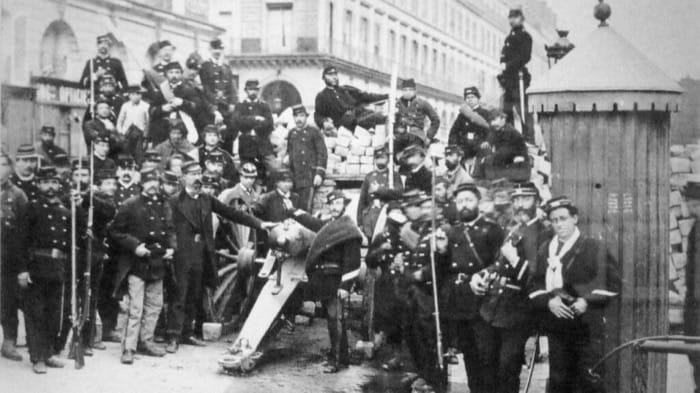
On March 26, 1871, in the wake of France's humbling defeat during the Franco-Prussian war of 1870, a revolutionary government sprang to life in Paris — one that history would come to remember as the Paris Commune. It was forged through an unlikely alliance of students and working-class Parisians who banded together to seize political power.
The Prussian army had held Paris under siege since September 1870, and by January 1871, the moderate republican government led by the 2nd emperor capitulated to Prussia. This collapse of the empire ignited fury among Parisians, who saw it as nothing short of betrayal. Fearing an uprising from the outraged populace, President Adolphe Thiers dispatched troops with orders to reclaim the cannons — used throughout the war — from the National Guard. That plan backfired spectacularly on March 18, when full-scale rebellion erupted. The National Guard militia, made up largely of workers who had fought to defend Paris during the siege, rallied together to protect their city.
With the National Guard firmly in control of Paris, French government leaders scrambled to flee for their safety. What followed was swift and decisive: the guard's central committee organized municipal elections for March 26, and from those elections, the commune emerged. Standing in direct opposition to the conservative national government, the newly elected commune council wasted no time pushing through a wave of measures that spoke to the hopes of the capital's working-class population. Among its priorities were ambitious social reforms, including the separation of church and state, the establishment of food kitchens, and the reduction of working hours for child laborers.
Yet the commune's bold vision would remain largely unfulfilled — its rule lasted a mere two months. The communards' steadfast refusal to recognize the French government's authority left the national leadership with little choice but to respond with force. On May 21, government troops launched an assault on the by-then weakened commune, bringing this historic rebellion to a dramatic end.