
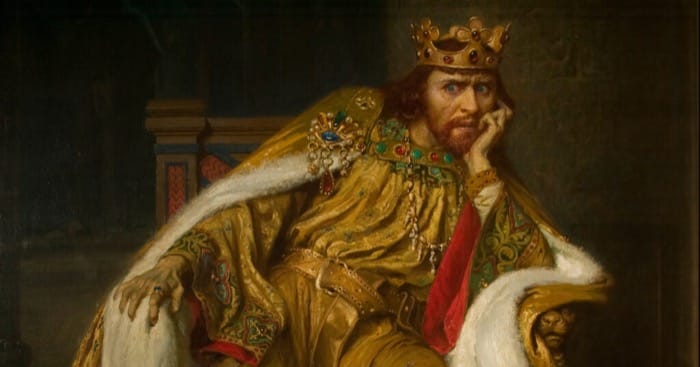
Born on 24 December 1166, King John dedicated his life to strengthening England and advancing its interests. Sadly, he passed away on 19 October 1216, still holding the reins of power when death claimed him.
As the son of Henry II of England and Eleanor of Aquitaine, King John came from a powerful lineage. His rule over England stretched from 6 April 1199 right up until the moment he drew his last breath.
His path to the throne opened when his brother Richard 1 (Richard the Lionheart) passed away. Once in power, King John found himself embroiled in constant friction with the barons and bishops alike. These ongoing clashes eventually cornered the nobles into compelling King John to honor the Magna Carta, an agreement designed to curtail his authority. This landmark legal document holds a treasured place in English history, standing as the first English bill of rights. Through the Magna Carta, the nobility experienced a political awakening that granted them a stronger voice in governance. The document made unmistakably clear that monarchs operated under limited rights and were bound to observe specific laws. Beyond reshaping English government, the Magna Carta went on to inspire governing systems in other nations as well.
While King John's reign was certainly noteworthy, England's historical record does not regard it as among the most successful. His repeated attempts to reclaim territories in France ended in utter failure.
The Reign of King John
Here are some highlights of King John's reign.
Rivalry with Arthur
Following the death of his brother Richard on 6 April 1199, King John claimed the throne. He secured recognition in both Normandy and England, receiving his crown at Westminster on 27 May, Ascension Day. However, Anjou, Maine, and Brittany refused to accept him, instead throwing their support behind Arthur of Brittany, the son of Geoffrey. Arthur waged war against King John for the crown with backing from Philip II of France. Though the struggle between King John and Arthur carried serious consequences, Philip ultimately sided with John over Arthur. The cost of this alliance was steep — King John had to acknowledge himself as Philip's liegeman in Normandy and Angevin.
Consumed by his determination to recover lost French territories, King John issued a decree in 1203 requiring every shipyard to contribute at least one vessel. The newly-built Portsmouth Naval Base faced even greater demands, being expected to supply many ships. What began as a military necessity turned into an unexpected boon for the maritime industry, spurring notable advances in ship design. To this day, King John is credited with founding the modern Royal Navy.
Amid the escalating cycle of conflict and retribution, Arthur made a bold move to kidnap King John's grandmother Eleanor of Aquitaine, at Mirebeau. The attempt backfired spectacularly — Arthur was defeated and captured by King John's forces. Initially imprisoned at Falaise, Arthur was later moved to Rouen. From the moment of his capture, Arthur's fate became a mystery lost to history. Nevertheless, it is believed that King John had him murdered, an act that cements King John's reputation as a ruthless leader.
King John and the Bordeaux
In 1203, King John barred the citizens and merchants of Bordeaux from accessing the Grande Coutume. Furious at losing this key export tax, the people of Bordeaux joined forces with Bayonne and Dax, forming a partnership aimed at undermining the French crown's acquisition efforts. The opening of ports gave Gascon merchants their first-ever access to the English wine market. By 1204, John extended comparable exemptions to Poitou and Rochelle.
The French Seizing Normandy
When Rouen fell in June 1204, Philip seized the opportunity to annex Normandy along with portions of Poitou and Anjou. King John desperately needed funds to maintain his army, yet the loss of French territories like Normandy had slashed state revenue. Reclaiming what had been taken would demand heavy taxation.
Dispute with the Pope
A bitter confrontation erupted between King John and Pope Innocent III following the death of the Archbishop of Canterbury Hubert Walter on 13 July 1205. At the heart of the conflict lay a disagreement about who should rightfully inherit the office. As tensions escalated, King John took the drastic step of shutting down all the churches.
Sealing of Magna Carta
On 15 June 1215, King John convened with fellow leaders and French and Scottish allies at Runnymede, near London. It was during this gathering that they consented to sign the great charter, Magna Carta. Among its provisions, the charter created a council of 25 barons. It also put forward new laws addressing illegal imprisonment, access to instant justice, and parliamentary assent for taxation. In the aftermath, however, King John began scheming to undermine the charter, having sealed it not of his own free will but under coercion.
The Death of King John
King John became caught up in a fatal train accident as he attempted to navigate a safe path around the marshy area. The incident devastated him, taking a severe toll on both his mental state and physical well-being. Ultimately, King John succumbed to dysentery at Newcastle. His body was laid to rest at Worcester Cathedral in the West Midlands. Upon his death, the crown passed to his nine years old son.