
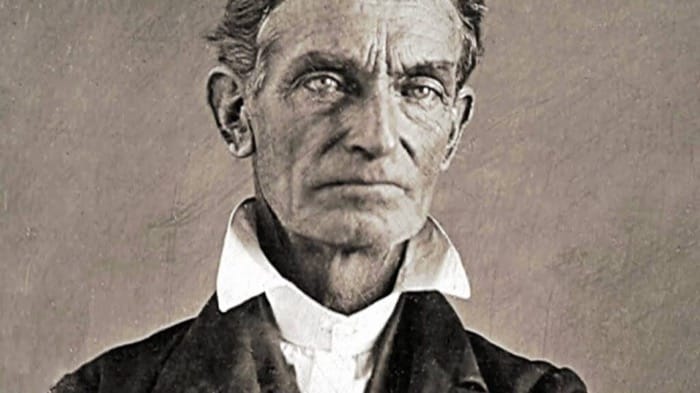
Determined to spark a slave rebellion that would establish a free state for African Americans, radical abolitionist John Brown set his sights on an audacious plan. On October 16, 1859, he spearheaded a minor attack on the U.S. military arsenal at Harpers Ferry, Virginia.
John Brown witnessed the beating of a young slave
Nothing about John Brown's early years hinted at the notorious path he would eventually follow. Born on May 9, 1800, in Torrington, Connecticut, he was the fourth of eight children raised by Owen and Ruth Mills Brown. At just 12 years old, John watched as a young slave he personally knew was brutally beaten. That heartbreaking moment left a lasting mark on him, igniting a commitment to abolitionism that would define the rest of his life.
John tied the knot with Dianthe Lusk in 1820, and together they welcomed seven children before her passing in 1832. The following year, he married Mary Ann Day, and over the course of 21 years, the couple had 13 children. Between 1820 and 1850, John cycled through various occupations to provide for his growing household. Persistent financial hardships drove the family to relocate frequently across the northeastern United States in search of stability. The murder of abolitionist Elijah P. Lovejoy deeply unsettled John, and from that point forward, he pledged his entire existence to the destruction of slavery.
John Brown's life in Springfield, Massachusetts
John made his way to Springfield, Massachusetts, in 1846—a city that served as a bastion of the anti-slavery movement. He became a member of the Stanford Street church, an institution founded by African American abolitionists. Deeply moved by the speeches of Fredrick Douglas and Sojourner Truth, John pressed forward with even greater resolve. During his time in Springfield, he threw himself into the operations of the Underground Railroad, enlisting his own sons to help transport and guide enslaved people fleeing the South through the North and onward into Canada.
Harper's Ferry
By 1859, John was leading attacks aimed at liberating enslaved people in regions where slavery was rife, particularly across the Midwest. He had the opportunity to meet Harriet Tubman and Frederick Douglass, activist and abolitionist, respectively. Both Tubman and Douglass proved instrumental in strengthening John's conviction that slavery had to be fought head-on.
Tubman lent her support to John's assault on slaveholders and the United States military armory at Harpers Ferry, Virginia. With the backing of enslaved people, John and Tubman succeeded in their strike against the slaveholders. John held out hope that this bold move would lay the groundwork for a larger revolt. Historians frequently describe the Harper's ferry attack as "a dress rehearsal for the civil war."
To carry out his plan, John recruited 22 men along with his sons Owen and Watson and other freed enslaved people. The entire group underwent military training to prepare for the rival attacks.
John Brown's raid
Launched on October 16, 1859, the operation resulted in the capture of Colonel Lewis Washington, a distant relative of George Washington. Despite this dramatic seizure, the Washington family continued owning enslaved people.
It was Owen Brown who led the contingent responsible for kidnapping Washington. Meanwhile, under John's direction, the remaining men raided herpes. Together, this group rounded up the pro-slavery leaders in town and seized the weapons.
John Brown's Fort
John's band managed to take numerous local slave-owners captive. However, resistance from the townspeople mounted by the end of the 16th day. Locals organized a militia that seized control of a bridge spanning the Potomac River, severing a critical escape route for John and his followers.
John Brown's body
Following his arrest, John was escorted to the courthouse near Charles Town by Lee and his men. He remained imprisoned until his trial commenced. Charged with treason against the Commonwealth of Virginia, John faced the ultimate penalty. On December 2, 1859, at 59 years old, he was hanged. Lee and pro-slavery activist John Wilkes Booth were both present to witness the execution.