
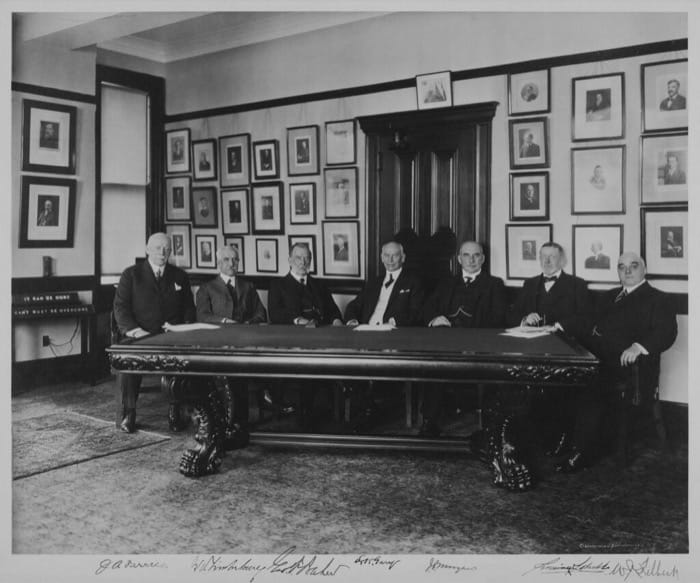
On February 25, 1901, the financier J. P. Morgan brought U.S. Steel into existence, formally incorporating what would become a landmark enterprise. Morgan was a towering figure on Wall Street during the Gilded Age of the United States—a corporate banker and financier whose influence shaped the era. That era, spanning roughly the last thirty or so years of the 19th century, saw the country surge forward through rapid economic growth and expanding industrialization. It was precisely this transition into a booming industrial society that J. P. Morgan leveraged when he assembled U.S. Steel at the beginning of 1901.
The new corporation was born from a massive merger that Morgan financed, bringing together three dominant steel producers: the Carnegie Steel Company, Federal Steel Company, and National Steel Company. Behind these firms stood Andrew Carnegie, Elbert H. Gary, and William Henry "Judge" Moore, respectively. Pulling off the deal came at a staggering price—$492 million in total, a figure that translates to roughly $15.31 billion when adjusted for inflation today.
With production now consolidated under a single corporate umbrella, U.S. Steel rapidly ascended to become both the world's largest steel producer and the biggest corporate entity ever assembled up to that point. At its peak, the company carried a jaw-dropping valuation of $1.4 billion—equivalent to $43.6 billion in today's money. This milestone made it the first company to surpass the one-billion-dollar mark in value, even without adjusting for inflation.
The company planted its headquarters in the Empire State Building in Manhattan, New York City, where it would remain a prominent tenant for close to a century. As the organization matured, Charles M. Schwab—an American steel magnate who had been serving as an executive at Carnegie Steel—stepped into the role of U.S. Steel's first president. To J. P. Morgan, this appointment made perfect sense: after all, it was Schwab who had originally proposed the enormously successful merger in the first place.