
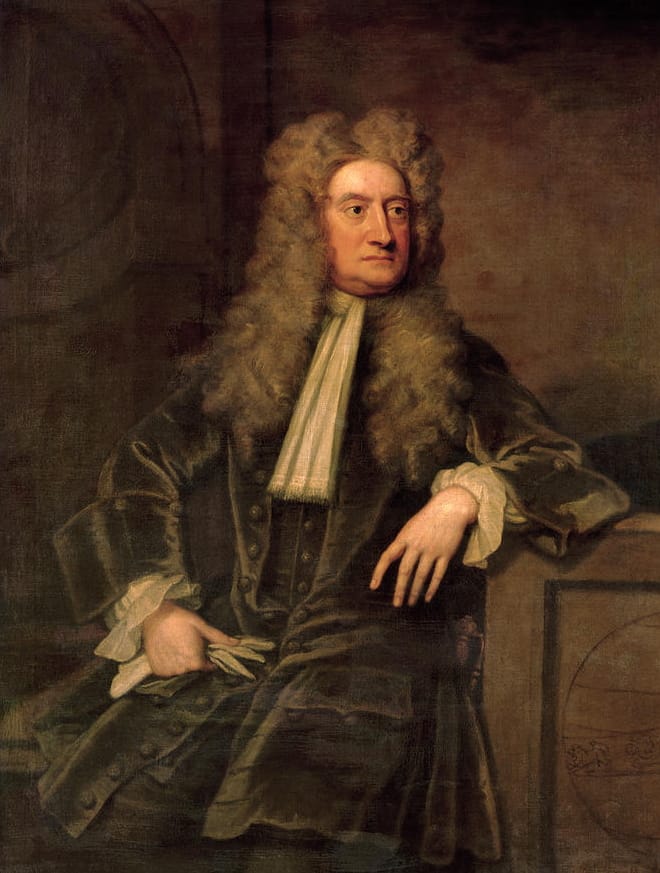
During the late summer of 17th century England, a work years in the making finally saw the light of day — Isaac Newton's debut publication. After Newton had completed his initial draft nearly two years earlier, The Royal Society of England released Principia to the world on July 5th, 1687.
Within the pages of Principia, Newton brought together some of his most groundbreaking discoveries spanning both science and mathematics. The two towering ideas that run through the entire work are the Laws of Motion and Newton's Law of Universal Gravitation, serving as the foundational pillars upon which everything else rests.
Through the Laws of Motion, Newton delved into the complexities governing how physical objects move, providing investigation and explanation of their behavior. His Law of Gravitation, meanwhile, declares that "every particle attracts every other particle with a force that is proportional to the product of their masses." To demonstrate these theories, Newton relied on intricate empirical observations paired with inductive reasoning. Across the globe, scientists and philosophers hailed this achievement as a powerful unification — bridging the phenomenon of gravity with the puzzling behaviors long observed in astronomy.
What Newton accomplished with these concepts and equations was nothing short of extraordinary: he established the bedrock of Classical Mechanics, producing one of the most paramount works in the history of science! Sir Isaac Newton will eventually create two more editions to his work, adding on new substance and correcting the errors he found in the first edition of Principia.
Remarkably, even though the author's illustrations of these principles were truly groundbreaking, the wider world needed almost a century before it would embrace Newton's theories as coherent and reliable.
Yet once that acceptance finally arrived, it unlocked an entirely new lens through which humanity could understand the world around it. Where conjectures and hypotheses had once been our only tools, science now carried us forward with real answers. And so, July 5th, 1687, endures as the day Newton shared his contributions with civilization, altering the trajectory of history forever.