
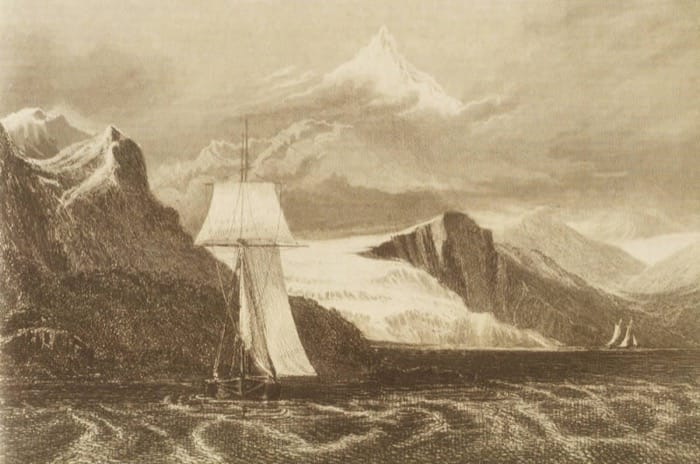
When the HMS Beagle sailed up the Derwent River on February 6, 1836, Charles Darwin got his first glimpse of Hobart in Van Diemen's Land — the place we now call Tasmania. The ship had departed Sydney six days earlier, and the arrival was met with cold, squally conditions. Given that the river's mouth bore the rather ominous name Storm Bay, Darwin couldn't help but observe with dry humor that the weather lived up to it.
As was common among naturalists and navigators of that era, Darwin's initial observations of Van Diemen's Land turned out to be off the mark. He characterized the shoreline as featuring "extensive Basaltic platforms…" but subsequent studies would reveal that these rock formations were actually dolerite.
Over a period of around ten days, Darwin explored the local geology and took note of how much damper the climate was compared to Sydney. One particularly memorable excursion brought him to the summit of Mt. Wellington, where he marveled at enormous Eucalyptus trees and gigantic ferns tucked into the ravines.
Darwin didn't limit himself to scientific pursuits during his stay — he also made time to socialize with figures from the English Society, among them George Frankland and Sir Alfred Stephen.
This stopover in Van Diemen's Land represented just a brief chapter in the HMS Beagle's 5-year circumnavigation of the globe. By this point, the voyage was actually in its final year, with the ship ultimately returning home in October 1836.
Darwin's journal from the expedition went on to be published as "The Voyage of the Beagle," earning him broad recognition and respect. He would later reflect that this journey stood as the most important event of his life, one that shaped the entire course of his career.