
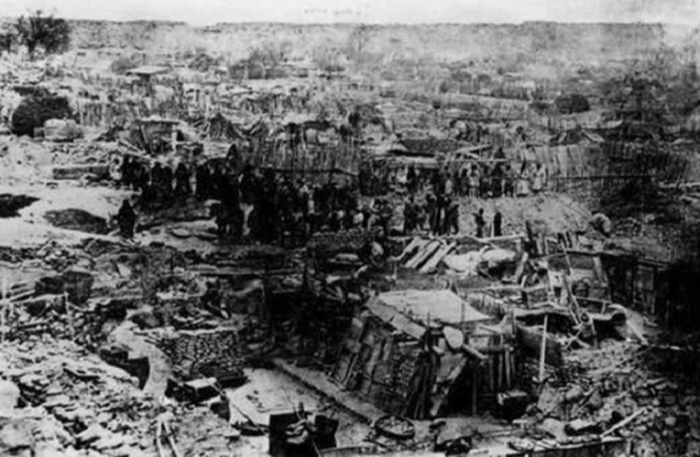
The devastating earthquake that struck Haiyuan County in the Republic of China's Ningxia Province on December 16, 1920, remains one of history's most catastrophic seismic events. Because Gansu Province was part of Ningxia at the time, this disaster is sometimes called the 1920 Gansu earthquake. Striking at approximately 19:05:53 Gansu-Sichuan time, the 7.8 magnitude quake unleashed a punishing three-year series of aftershocks that followed in its wake.
Chinese media reports today place the earthquake's magnitude at 8.5 on the Richter scale, though no specific seismic scale was mentioned. The zones surrounding Lijunbu-Haiyuan-Ganyanchi were utterly destroyed, with the tremor reaching the maximum Mercalli intensity level (XII Extreme).
The human toll was staggering. Approximately 73,000 lives were lost in Haiyuan County alone, while a landslide buried the village of Sujiahe in Xiji County. Guyuan County saw nearly 30,000 additional deaths, and almost every residence in Longde and Huining was demolished. Damage (VI–X) was reported across seven provinces and regions, reaching major cities such as Xining, Taiyuan, Yinchuan Xi'an, and Lanzhou. The quake's reach was extraordinary — it could be felt from Nei Mongol (Inner Mongolia) all the way to the Province of Qinghai, stretching south through the middle of Sichuan Province to the Yellow Sea.
The United States Geological Survey published a report claiming a total of 200,000 casualties, whereas the Catalog of Damaging Earthquakes in the World, published by the International Institute of Seismology and Earthquake Engineering (through 2008), placed the figure at 235,502.
Beyond the immediate destruction, harsh weather conditions drove the death toll even higher. Survivors were reluctant to build anything beyond temporary house structures due to frequent aftershocks, and the brutal winter season claimed many lives among those who had managed to survive the initial quake. By 2010, Chinese seismologists had amended their estimate to 273,400 casualties.
In Zhangjiachuan, the earthquake brought down the roof of a mosque where Ma Yuanzhang, the leader of the Sufi Jahriyya Muslim Hui sect, was present along with his son. Both were killed in the collapse.
The earthquake left dramatic scars across the landscape. Surface faulting extended for roughly 200 kilometers (125 miles), stretching from Lijunbu to Jingtai. Numerous landslides and ground fractures tore through the Epicentral area, damming some rivers and redirecting others entirely. Remarkably, the seismic energy traveled far enough to produce seiches in two lakes and three fjords in western Norway.