
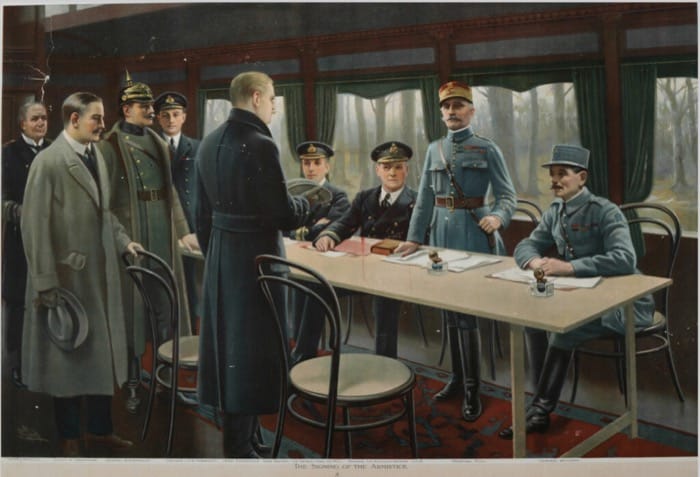
When fighting ground to a halt between Germany and the Allied powers on November 11, 1918, it was thanks to the WW1 Armistice — a ceasefire agreement, not a formal peace treaty. This truce brought an end to hostilities along the Western Front, but the First World War wouldn't officially conclude until the Treaty of Versailles was finalized after more than half a year of painstaking negotiation.
So why did Germany come to the table? Their Spring Offensive in 1918 had succeeded in capturing territory, but it came at a devastating cost — their supplies and reinforcements were completely drained. This left an opening for the Allies, who seized the momentum and drove German forces back through their remarkably effective 100 Days campaign.
Ludendorff, the German military commander, initially sought an armistice purely as a breathing spell — a chance for his exhausted soldiers to recover before resuming the fight. By October 17, he had actually reconsidered, believing his forces could carry on without rest. But conditions deteriorated rapidly, forcing him to reverse course yet again. The mid-1918 Allied blockade had left German troops suffering from growing deprivations and near-starvation, making continued resistance increasingly untenable.
Once any realistic prospect of victory on the Western Front had vanished, the German population overwhelmingly wanted peace — even if that meant submitting to punishing terms. The conditions laid out in the Armistice included the following:
- The Germans were to evacuate occupied territory in France and Belgium.
- The Allies were to occupy the area ten kilometers east of the Rhine, and the rest of the Rhineland region declared a demilitarized zone.
- The German military was to surrender war material such as ships, planes, and machine guns.
Back on the home front, four years of hardship combined with news of battlefield defeats had sparked social unrest and revolutions across Germany. With a crumbling military and a domestic population that had lost the will to continue, Germany found itself with no real choice but to accept the Allies' demands.
In the end, on October 20, 1918, Germany consented to the unilateral settlement of conditions for the Armistice and the evacuation, holding onto the prompt belief that Wilson would not allow an insult to Germany's honor.