
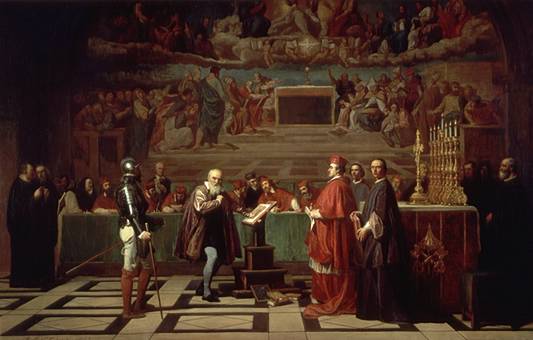
A physicist and astronomer who spent his life spanning the late sixteenth and early seventeenth centuries, Galileo Galilei holds a place in history that many regard as nothing less than the father of modern science. Among the earliest and most prominent voices championing heliocentrism — the revolutionary idea that the sun, not the Earth, sits at the center of the solar system — Galileo found himself on a collision course with religious authority. That collision came to a head on February 26, 1616, when the Catholic Church issued a direct order: abandon this belief, or face torture and death.
The Church's position at the time was rooted in its interpretation of the Bible, which it held as proof that the Earth occupied the center of the universe and that the sun revolved around it — not the reverse. But the invention of the first telescopes changed everything. Suddenly, astronomical observations grew precise enough to demonstrate that this worldview simply didn't hold up. Astronomers began openly challenging the old model, and that defiance brought consequences. Scientists like Galileo soon found themselves confronted by visits and threats from the Inquisition.
The specter of what had happened to Giordano Bruno surely loomed large when Galileo stood before Church officials to hear charges of heresy leveled against him. Bruno, a fellow scientist and supporter of heliocentrism, had recently paid the ultimate price for his convictions — burned at the stake. Faced with the same institution that destroyed Bruno, Galileo chose to publicly recant his beliefs.
Yet his recantation was anything but straightforward — it practically broadcast his true feelings on the matter. In essence, Galileo declared that he had never actually been a heretic. However, since the Church was commanding him to recant, then recant he would — despite the fact that his arguments supporting heliocentrism were, in his view, incredibly strong. He even threw in a promise that he would never again utter anything that might arouse suspicion. It was, in every sense, a truly classic "sorry/not sorry" pseudo-apology.