
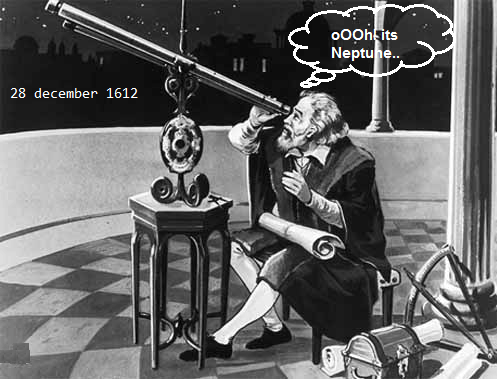
On December 28, 1612, while carefully sketching Jupiter's moons, Galileo Galilei recorded something intriguing in his notebook — an object he took to be a "fixed star," spotted through his primitive telescope in the vicinity of Jupiter. What he didn't grasp at the time was that this wasn't a star at all. Because of its vast distance from the sun and its painfully slow relative movement, the true nature of what he'd observed eluded him: it was actually an undiscovered planet that would eventually come to be called Neptune.
Remarkably, it would take another 233 years before Neptune received its official discovery. In 1846, Johann Gottfried Galle — working from calculations supplied by Urbain Le Verrier and Couch Adams — formally identified the planet. During those intervening centuries, numerous other astronomers had also caught glimpses of Neptune without recognizing it for what it was. With a revolution period of 165 years and only a faint magnitude visible in the night sky, confirming its planetary status proved exceedingly difficult given the telescopes of the era.
For decades, astronomers were well aware that Galileo had made this observation, but the prevailing assumption was that he simply hadn't understood what he was looking at. That consensus held firm until 2009, when David Jamieson, a physicist at the University of Melbourne, put forward a groundbreaking new theory. Through meticulous study of Galileo's notebooks, Jamieson came to a striking conclusion: the great astronomer had actually known what he had found.
Roughly a month after his first sighting, on January 28, 1613, Galileo turned his attention back to the "fixed star" and noticed that it had moved — confirming it was indeed a planet. According to Jamieson's theory, Galileo had communicated his discovery through an anagram, but the Catholic Church, wary of heresy, had acted to suppress it.
Adding a fascinating twist to this story, a rare planetary event occurred in the window between Galileo's two observations. Had he pointed his telescope skyward just before dawn on January 4, 1613, he would have witnessed Neptune emerging from behind Jupiter.