
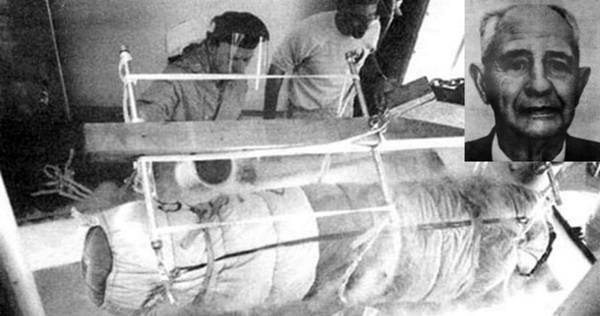
On January 12, 1967, Dr. James Bedford — a psychology professor with an otherwise unremarkable life — succumbed to cancer, a tragically common cause of death. What happened next, however, was anything but ordinary. Dr. Bedford had volunteered to be the first person cryonically preserved, accepting a free offer extended by the Life Extension Society to whoever stepped forward first for their experimental procedure.
Immediately following his death, his body was kept oxygenated through artificial respiration and heart massage, ensuring blood continued to flow and his brain remained preserved as his body temperature was gradually lowered. A preservative chemical called dimethyl sulfoxide was then injected into his system, after which he was packed in dry ice and ultimately stored in super-cold liquid nitrogen.
Here's the unfortunate catch: dimethyl sulfoxide turns out to be a pretty poor cryo-preservative. It causes ice crystals to form within the brain and other organs, meaning that the intricate microscopic structures of Dr. Bedford's brain have almost certainly been destroyed beyond recognition.
To be fair, no one could have known better at the time. Cryonic preservation was an entirely new frontier of science, and the knowledge simply didn't exist yet. Today's cryonics practitioners rely on vitrification — a far superior cryo-preservative technique that avoids ice crystal formation altogether, leaving the brain's structure intact.
So what does this mean for Dr. Bedford? He's not just waiting for someone to invent a cure for cancer and figure out how to revive frozen human beings. He'll also need scientists to develop a way to repair the extensive damage done to his brain.
Though his body has been relocated several times over the decades, Dr. Bedford remains preserved to this day at the Alcor Life Extension Foundation.