
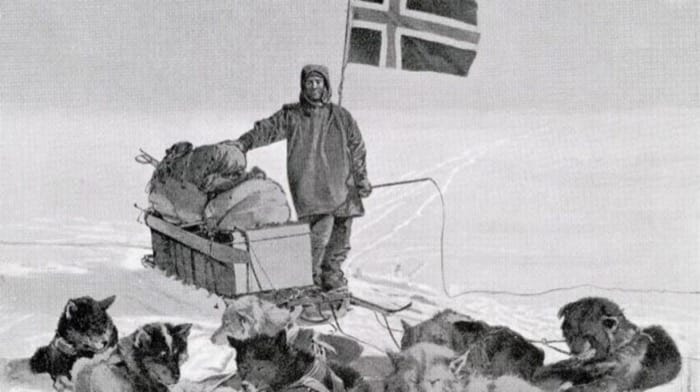
Roald Amundsen, widely regarded as one of the most remarkable figures in the history of polar exploration, made history on December 14, 1911, when he became the first person to set foot at the South Pole. Before launching the expedition that would culminate in this achievement, Amundsen sailed to Antarctica's Bay of Whales, ultimately beating his British competitor Robert Falcon Scott to the prize.
Amundsen was born on June 16, 1872, and went on to lead a life defined by groundbreaking exploration. Among his many firsts, he successfully navigated the Northwest Passage — piloting his 47-ton sloop around the Canadian coast between 1903-1905.
His polar ambitions stretched back even further. In 1897, he served as first mate on a Belgium expedition that was among the earliest to endure a winter in the Antarctic. By 1909, he had set his sights on being the first to reach the North Pole — only to discover that American Robert Peary had claimed that distinction before him.
Turning his attention southward in 1911, Amundsen sailed his ship to the Bay of Whales and established a base camp positioned 60 miles nearer to the South Pole than his rival Robert Falcon Scott's camp. Their approaches to the journey differed dramatically: Scott relied on dogs, Siberian motor sleds and Siberian ponies, whereas Amundsen depended exclusively on sleigh dogs to make the trek. In the end, Amundsen reached the pole a full month ahead of his competitor — whose frozen body would later be discovered less than 11 miles from his camp.
In 1926, Amundsen added yet another first to his extraordinary résumé by becoming the first person to fly an airship over the North Pole.
Amundsen's remarkable life came to an end on June 18, 1928, when he perished during an attempt to rescue a fellow explorer at sea.