
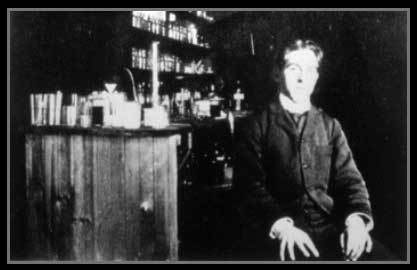
Background
Born on January 1, 1875, in Chicago, Emil Herman Grubbe was the son of immigrants who had made their way to the United States. Their decision to cross the Atlantic would eventually have far-reaching consequences for the history of medicine.
When he was just 15 years old, Grubbe embarked on his medical education at Northern Indiana Normal School at Valparaiso. After wrapping up his formal premedical training, Emil Herman Grubbe enrolled at Hahnemann Medical College of Chicago in 1895 and went on to earn his degree from that institution in 1898.
Breast Cancer
January 29, 1896, stands as a turning point in medical history—yet surprisingly few people recognize the name Dr. Emil Herman Grubbe. On that date, he made the bold decision to treat a patient's breast cancer using radiation. The path to this breakthrough began in 1895, when Dr. Wilhelm Roentgen discovered x-rays. Just a year later, in 1896, Dr. Emil Herman Grubbe put those x-rays to therapeutic use against a patient's breast cancer—and validated his approach by saving that patient's life.
Dr. Emil Herman Grubbe (1875-1960) carved out a truly distinctive place in medical history through his pioneering work in radiation therapy, as noted earlier. He would go on to establish the first radiation therapy facility, located at South Cottage Grove Avenue in Chicago.
Dr. Grubbe
There is little question that Dr. Emil Herman Grubbe was a remarkable individual who operated well ahead of the curve. He was known to carry a superior complex when measured against his contemporaries, yet Dr. Herman Grubbe remained a colorful and vivid personality throughout his career. Even so, his story embodies the very essence of a self-made man, particularly within the field of medicine. It is for this reason that historians frequently credit Dr. Emil Herman Grubbe as the first physician to use radiation in the treatment of breast cancer.