
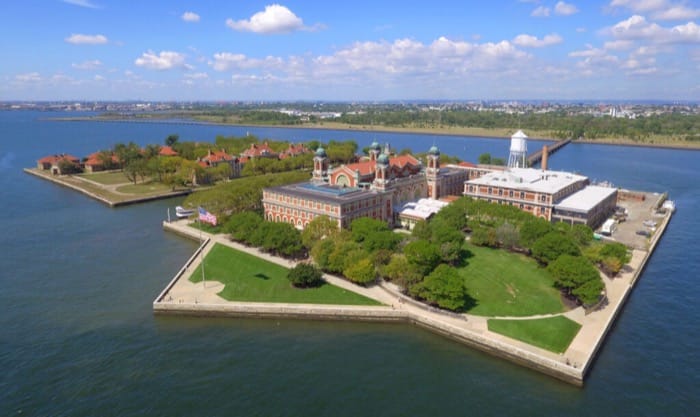
On January 1, 1892, as the new year dawned, Ellis Island began its storied role as a United States immigration inspection station. Three ships had already made their way to the harbor during preparations and sat waiting with anticipation to pull into the dock. That very first day saw an impressive 700 newcomers pass through the station's processing facilities, and by the close of that same year, a remarkable 450,000 immigrants had entered the United States via Ellis Island. Fast forward fifty years to 1942, and an astonishing twelve million individuals had been welcomed through the island's gates into a melting pot nation broadly regarded as a beacon of hope, opportunity, and prosperity.
Long before it served as a gateway for immigrants, Ellis Island carried a history all its own. The Mohegan people, Native Americans residing on the neighboring island of Kioshk — which would eventually come to be called Gull Island — were the island's original inhabitants. In 1630, the Dutch acquired the land and presented it as a gift to Michael Paauw, one of Manhattan's early colonizers.
Roughly a century later, as the Revolutionary War loomed, a merchant named Samuel Ellis bought the island. His vision was to operate a tavern catering to the fishermen who regularly visited the surrounding shores, but the venture proved short-lived — it shuttered following Samuel's death. Fourteen years after he passed away, the state of New York acquired the island for $10,000, a sum that would translate to approximately $280,000 in today's dollars when adjusted for inflation.
Following that purchase, the island transitioned into a hub for U.S. defense operations. Military use kicked off with the start of the War of 1812, during which the island primarily functioned as an ammunition storage site and a location for constructing fortification apparatuses. As defense demands diminished, so did the military presence — until the Civil War reignited its strategic importance, this time as an arsenal housing weapons and ammunition.
In its more modern chapter, Ellis Island threw open its doors to the public as a tourist destination in 1976, drawing more than 50,000 visitors during that inaugural year. The experience expanded further in 2001 when the American Family Immigration History Center (AFIHC) opened its doors. Most recently, the Ellis Island National Museum of Immigration launched on May 20, 2015, earning the popular nickname "The Peopling of America."