
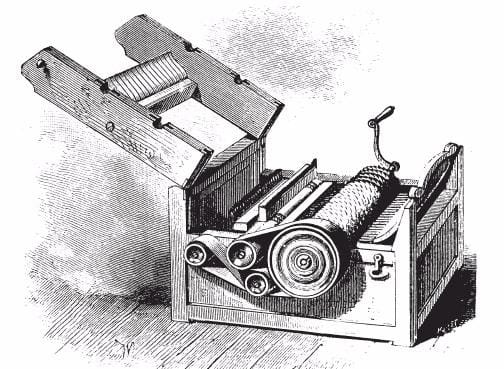
On March 14, 1794, Eli Whitney secured a patent for his revolutionary cotton gin — a moment that showcased his remarkable talents as an inventor and engineer. Ironically, it also marked the beginning of a journey that would demonstrate just how poorly those talents translated into the business arena.
Whitney's mechanical aptitude showed up early. As a youngster, he crafted his own violin and even managed to build a functioning nail forge. By his teenage years, he had landed work as a blacksmith — a trade demanding serious technical skill. But the blacksmith's life eventually lost its appeal, and he headed off to college a few years later with the goal of becoming a lawyer. Upon graduating, however, he took a different path entirely and became a tutor. It was during his time working in Georgia that he became captivated by a persistent agricultural challenge: how to efficiently remove seeds from picked cotton.
Doing the job by hand was an agonizingly slow process. Whitney's solution was ingenious — he designed a machine that used toothed wheels to push cotton fibers through a wire mesh, stripping the seeds away in the process. He dubbed his invention the cotton engine, which people quickly shortened to cotton gin. Almost overnight, cotton transformed from a crop that barely turned a profit into one that was extraordinarily lucrative.
Where Whitney stumbled was in his business strategy. He attempted to charge users 40% of the profits generated by his machines — a demand that did not sit well with potential customers. Their response? They simply built their own versions by copying Whitney's design. Whitney poured his resources into lawsuits against these imitators, but the legal battles were unsuccessful and left him financially ruined. In the end, he pivoted to licensing his machine at a much more reasonable rate, though the price remained on the high side.