
Japan's military aggression in Asia escalated dramatically over the course of the 1930s. It all began in 1931, when local Japanese officers staged a fabricated Chinese attack as a pretext to invade China, ultimately leading to the establishment of the puppet state of Manchukuo. Then, in 1937, Japanese forces pushed even deeper into Chinese territory, triggering the Second Sino-Japanese War.
Western nations grew increasingly alarmed — not only by the Rape of Nanjing and the broader pattern of atrocities Japanese soldiers committed in China, but also by the mounting fear that Japan's aggressive militarism might eventually be directed at them. This unease culminated in a joint decision in 1941 to cut off exports of oil, iron ore, and steel to Japan, resources without which its war machine simply could not function. Faced with the stark choice of watching its economy crumble or abandoning its recently conquered territories, Japan chose a third path: war against the western powers.
The Japanese strategy centered on rapidly capturing key objectives throughout the Pacific region, then establishing and defending a strong perimeter. The endgame was to hold firm until the western powers grew weary enough to negotiate a peace that would recognize Japan as the dominant force in Asia. Central to this plan was the surprise assault on Pearl Harbor on December 7 of 1941 — a strike designed to cripple the U.S. Pacific Fleet and prevent it from disrupting Japanese military operations targeting the overseas territories of the United States, the United Kingdom, and the Netherlands.
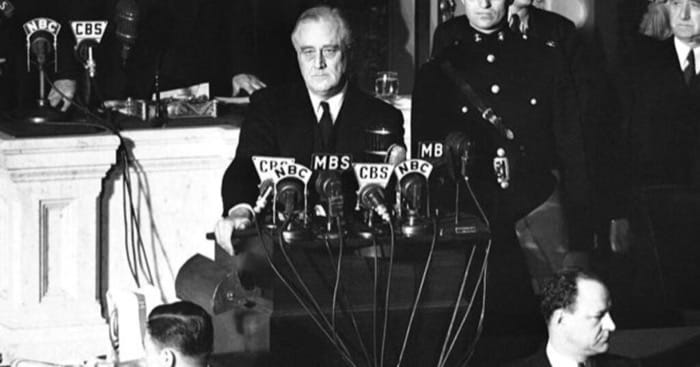
The American reaction was one of absolute fury. The very next day, U.S. President Franklin D. Roosevelt delivered his now-legendary address to the U.S. Congress — widely known as the "Day of Infamy" speech — a phrase that has shaped U.S. rhetoric ever since. Shortly thereafter, on December 11 of 1941, both Germany and Italy declared war on the United States, bringing the US fully into WWl.