
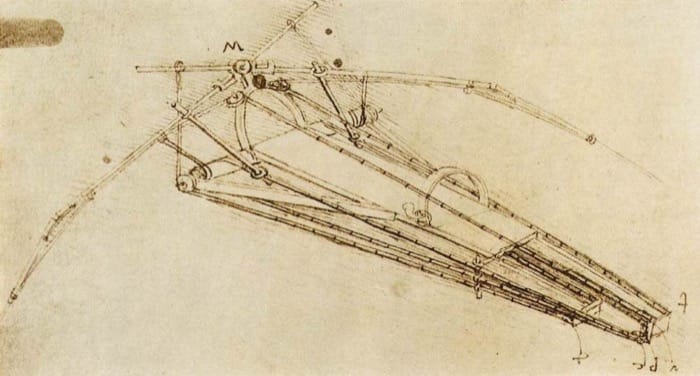
Few figures in history have captured the imagination quite like Leonardo da Vinci, widely regarded as one of the most brilliant engineers of his era. Among his many ambitious creations, perhaps none was more groundbreaking than his revolutionary flying machine — a device that was truly unlike anything the world had ever encountered.
Designed to mimic a bird, the machine boasted an impressive 33-foot wingspan. What truly set it apart, though, was how it was operated. A pilot would lie flat between the wings, maneuvering the craft through a hand crank connected to a rod-and-pulley system. To keep the structure as light as possible, the frame was covered with a membrane constructed from pine and raw silk.
The test flight took place on February 3, 1496 — and it ended in failure.
A flawed design was ultimately to blame for the machine's inability to fly. Yet this failure has sparked considerable speculation over the centuries. Many believed da Vinci might have intentionally sabotaged the test, driven by a desire to prevent his invention from falling into military hands. The fact that he later fled the country in protest of military policies has only fueled these rumors, leaving people to wonder whether there was more to the story than a simple engineering shortcoming.
A true Renaissance polymath, Leonardo da Vinci came into the world on April 15, 1452, during the High Renaissance era, in Anciano, Italy. Throughout his remarkable life, he wore many hats — painter, scientist, theorist, sculptor, and architect among them. His artistic legacy alone would have secured his place in history, with masterworks like the Last Supper, completed in 1498, and the iconic Mona Lisa, painted in 1503.
Leonardo da Vinci passed away on May 2, 1519, in France.