
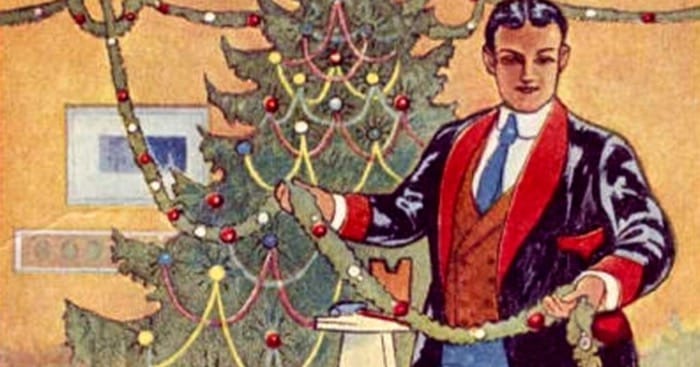
On December 22, 1882, a resourceful inventor in New York City hit upon a dazzling new application for electric lights — turning them into the world's first Christmas tree decorations.
That inventor was Edward H. Johnson, an associate at Thomas Edison's Illumination Company who would go on to serve as a vice president of the firm. At his New York residence, Johnson wrapped his Christmas tree with 80 small electric bulbs in red, blue, and white, all wired together on a single power line to create a glowing holiday spectacle.
It's worth noting that some historians actually give the credit for first using lightbulbs as Christmas decorations to Edison himself, Johnson's friend and partner in Edison's Illumination Company. Back in 1880, Edison had arranged electric lights around the outside of his laboratory at Menlo Park Laboratory to celebrate the holiday season. Passengers on passing railroad trains were treated to their very first look at an electrical lighting display as they rode by the illuminated building.
Still, Johnson deserves recognition for the leap of imagination it took to move those lights onto the tree itself — even if his idea came three years after Edison had already demonstrated the viability of light bulbs by stringing them around Menlo Park Laboratory.
Not everyone was immediately sold on the concept, however. Wax candles had graced Christmas trees since the mid-17th century, and many people were reluctant to abandon that tradition in favor of electric alternatives. Gradually, over the first few decades of the twentieth century, string lights caught on — first gaining popularity among wealthier households before eventually making their way into more modest homes.
The commercialization of this holiday staple took a major step forward in 1901, when the Edison General Electric Co. of Harrison, New Jersey, rolled out the world's first mass-produced Christmas tree lamps. These were offered as stringed sets containing nine sockets each.