
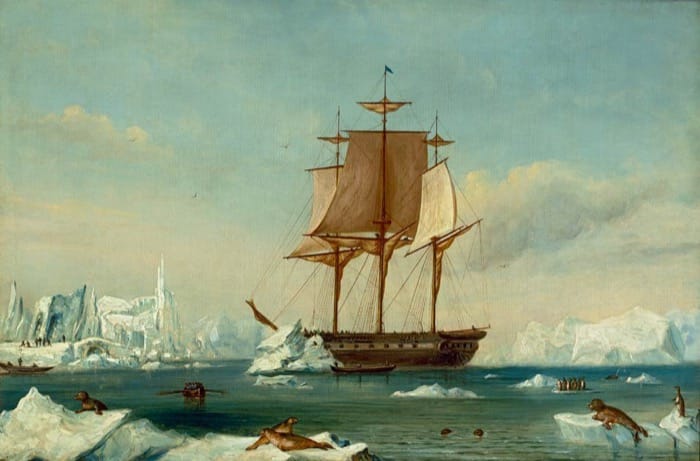
Years ago, the pursuit of reaching Earth's poles, claiming new territories, and advancing scientific understanding fueled fierce competition among nations, driven by both national pride and personal ambition. Although the ancient Greeks had long theorized that a southern landmass must exist to counterbalance the land north of the equator, no confirmed sighting of the 7th continent had ever been recorded. Among the countries eager to prove the existence of this mysterious southern land was the U.S.
In 1838, an ambitious lieutenant named Charles Wilkes received command of an entire fleet and was commissioned to venture into southern waters, tasked with gathering knowledge about weather patterns, uncharted land, and scientific data. The expedition made its way along the coast of Southern America before pushing into the Pacific Ocean. Then, on January 25, 1840, Wilkes spotted a massive wall of ice — and with it, the existence of the previously unknown continent of Antarctica was confirmed. Today, the eastern coast of Antarctica bears his name, known as Wilkes Land.
Four years after setting sail, the crew finally returned to America in 1842, their mission accomplished. As the young nation's first major voyage of exploration, it was a landmark achievement. Wilkes brought back a wealth of scientific knowledge that bolstered America's sailing ships position. Locked in a tight race with both the French and British over confirming the existence of the southern landmass, Wilkes emerged as the first person to site and explore the last continent.
The reverberations of this expedition extended well beyond American borders. It effectively marked the closing chapter of the age of discovery, a long era defined by mankind's consistent learning of details of our world. At last, the most unique continent — one with no permanent borders or constant size — had been found.