
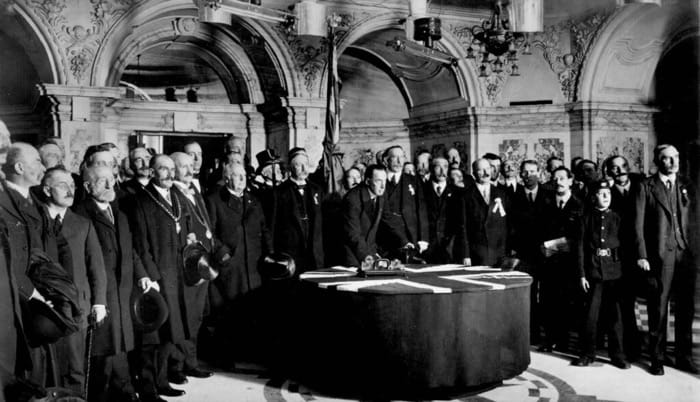
Ireland had been part of Great Britain during the late 1800s, but growing movements for independence began stirring up serious unrest, setting the stage for decades of bitter conflict between the two island nations. On March 31, 1920, the British government enacted the Irish Home Rule law, bringing an end to the prolonged and deeply rooted tensions that had plagued the region. Ironically, though, this very same legislation planted the seeds for an entirely new era of enduring strife.
Backstory
At the dawn of the twentieth century, Great Britain stood as one of the globe's dominant powers, presiding over a vast empire famously described as one on which the sun literally never set. Letting go of even a shred of control was simply not in the empire's nature, which meant Irish independence movements hit wall after wall. The fiercest resistance came from Parliament's House of Lords, which at that time wielded the authority to outright kill any bill. Frustrations boiled over so intensely on both sides that, by 1914, widespread fears of a British civil war were taking hold.
But then World War I erupted, and Germany suddenly consumed everyone's focus. The devastating influenza epidemic that followed the war reshaped the political landscape even further, so that by 1920, the situation looked dramatically different. Support for Irish self-governance had grown considerably within Britain, and crucially, the House of Lords had lost its ability to block legislation.
With this shifted reality, Britain passed the Home Rule Law on March 31, 1920, allowing the empire to redirect its dwindling resources toward broader priorities while handing Irish affairs over to the Irish themselves. Yet the consequences of this law were far-reaching and deeply divisive — it led directly to the partition of Ireland into British Northern Ireland and an Irish free state in the south, spawning conflicts and tensions that both Britain and Ireland have continued grappling with to this day.