
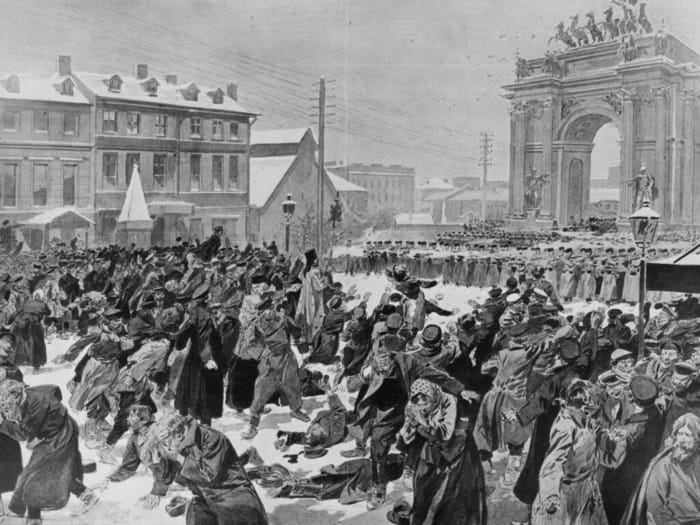
On the brink of military defeat against Japan in the Far East, czarist Russia found itself shaken by a wave of internal unrest that would come to be known as the Bloody Sunday Massacre in St. Petersburg.
Under the feeble leadership of Romanov Czar Nicholas II, who had come to power in 1894, Russia descended into unprecedented levels of corruption and tyranny. Haunted by fears that his dynasty could end—his sole male heir, Alexis, suffered from hemophilia—Nicholas became susceptible to the influence of disreputable figures such as Grigory Rasputin, the alleged mad monk. Russia's imperial ambitions in Manchuria had meanwhile sparked the Russo-Japanese War, which got underway in February 1904. At the same time, revolutionary figures were organizing abroad, with exiled Vladimir Lenin chief among them, assembling socialist rebel troops determined to topple the czar.
In an effort to drum up public enthusiasm for the deeply unpopular war with Japan, the Russian government authorized a November 1904 gathering of the zemstvos—the regional administrations originally created by Nicholas's grandfather Alexander II. The reform demands voiced during this congress went unmet, prompting more radical socialist and labor organizations to pursue a different course of action.
A group of workers, led by radical priest Georgy Apollonovich Gapon, marched on St. Petersburg's Winter Palace on January 22, 1905, seeking to deliver their petitions directly to the czar. The imperial forces responded by firing into the crowd, killing dozens and leaving many more wounded. The massacre ignited strikes and rioting throughout the kingdom, and Nicholas attempted to quell the unrest by announcing the creation of a series of representative assemblies, or Dumas, tasked with pursuing reforms.
Yet over the following decade, internal turmoil within Russia only deepened. The state demonstrated little genuine willingness to abandon its repressive practices, while radical socialist parties—Lenin's Bolsheviks foremost among them—continued gaining strength and edging ever closer to their revolutionary objectives. This simmering crisis would ultimately reach its breaking point more than a decade later, when World War I's pressures drained Russia's resources to rock bottom.