
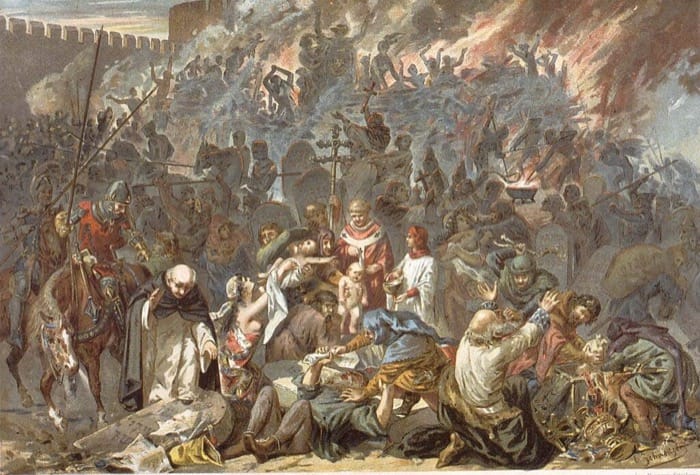
The massacre of Erfurt's Jewish community on March 21, 1349, stands as one of the darkest episodes of the Black Death era. Three years before this horrific event, the Bubonic Plague — also called the Black Death — had begun sweeping across Europe. No pandemic in history has matched the devastation wrought by the Bubonic, which killed millions throughout Europe, western Asia, and northern Africa. But the plague didn't just claim lives through disease; it also fueled waves of public unrest, and it was precisely this turmoil that set the stage for the killings in Erfurt, Germany.
Without the medical and biological understanding required to halt the plague's transmission, the pandemic spread with virtually nothing standing in its way. In the absence of scientific explanations, the Catholic majority — especially across France and Germany — sought answers through their faith. History has shown that during periods of severe public upheaval, marginalized groups frequently become scapegoats, bearing the brunt of fear and anger. During the Black Death, it was the Jewish community that found itself both accused and attacked.
As this dangerous scapegoating intensified, people grew increasingly radicalized by the notion that Jewish people had somehow caused the plague. The accusations didn't stop there — they spiraled further. The claim emerged that killing Jews would actually help stop the disease from spreading. What followed was a devastating surge of antisemitic violence that reached its terrible peak in the Erfurt Massacre.
How many perished? The exact death toll remains uncertain, with accounts placing it somewhere between 100 and 1,000 Jewish people murdered. Those who survived the violence either fled or were driven out of the city entirely. The brutality reached such extremes that some members of the Jewish community chose to take their own lives, setting fire to their homes while they remained inside.