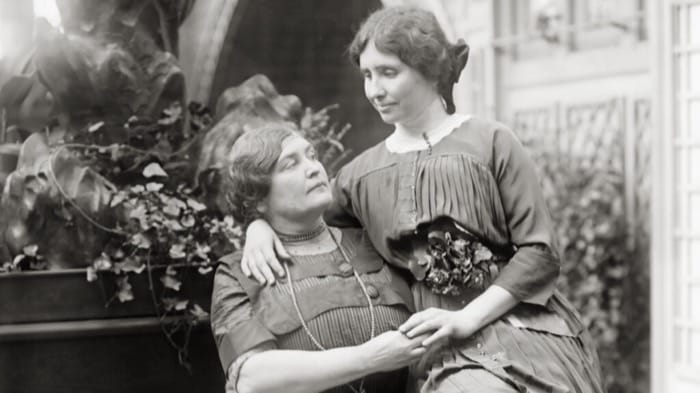
When Anne arrived at the Keller household in Tuscumbia, Alabama, on March 3, 1887, she was just 20 years old — and about to change a young girl's life forever. Helen Keller, rendered both deaf and blind by a devastating illness at 19 months of age, would go on to describe this pivotal day as her "soul's birthday." It marked the moment Sullivan began the painstaking work of teaching the six-year-old to communicate, spelling out words directly into her hand.
Before Sullivan's arrival, Helen had virtually no means of expressing herself to the people around her, relying only on a handful of imitative signs. Through a process of trial and error, Anne crafted an effective teaching method. She guided Helen's hand onto her face — thumb against the throat, first finger pressed to the lips, middle finger resting on the nose. This positioning allowed Helen to detect the vibrations produced by spoken words and translate them into sound.
The progress was remarkable. Within six months, the now seven-year-old Helen had mastered the manual alphabet, picked up the Braille system, and grasped some mathematics. By 1888, Helen had enrolled at the Perkins School, with Anne accompanying her and continuing to support her education every step of the way. Helen would ultimately graduate from Radcliffe College, making history as the first person with a serious disability to earn an undergraduate degree.
The New York Public Library later named her first book, "My Life Story," among the 100 most influential books of the 20th century — and it was only the beginning. Helen went on to author fifteen books in total. Together, she and her extraordinary teacher Anne dedicated the remainder of their lives to advocating for the blind, producing extensive writings on the subject and working relentlessly toward a uniform system of Braille. Helen passed away at her home in Connecticut in June 1968 after suffering a heart attack, at 87 years of age.