
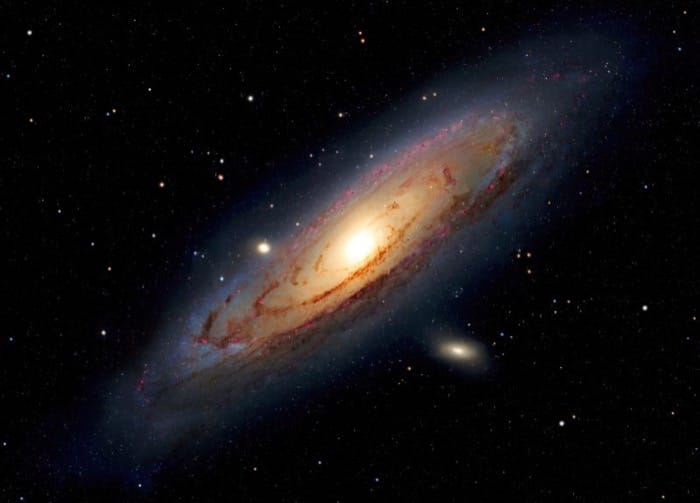
German astronomer Simon Marius made history on December 15, 1612, when he turned his telescope toward the sky and became the first person ever to view the Andromeda Galaxy through such an instrument. After measuring the galaxy's diameter, he offered a vivid description, comparing its appearance to the glow of a candle seen through a horn.
That said, Marius didn't actually discover Andromeda — his telescopic observation was really a rediscovery, made possible by the recent invention of the telescope.
Long before Marius pointed his lens skyward, humanity was already aware of the Andromeda Galaxy. The earliest known reference dates back more than 600 years before his observation, to 965 AD, when the Islamic astronomer Abd al-Rahman al-Sufi documented it in his work titled "Book of the Fixed Stars."
What Simon Marius is probably best remembered for, though, is his discovery and naming of Jupiter's four largest moons in 1610 — a feat accomplished at around the exact same time as Galileo Galilei made the very same discovery.
The trouble was that Marius didn't publish his results until 1614, when his book "Mundus Jovialis" finally appeared. This delay gave Galileo grounds to level accusations of plagiarism against him. Galileo refused to believe that Marius had independently observed the moons when he claimed he had, and these charges took a serious toll on Marius' reputation.
It took about 300 years for the record to be set straight. A Dutch jury of experts eventually reviewed the evidence and concluded that Marius did, in fact, discover the moons independently of Galileo at around the same time. Yet regardless of who might have gotten there first — Simon Marius or Galileo Galilei — it's the mythological names that Marius bestowed upon them — Io, Europa, Ganymede and Callisto — that remain in use to this day.