
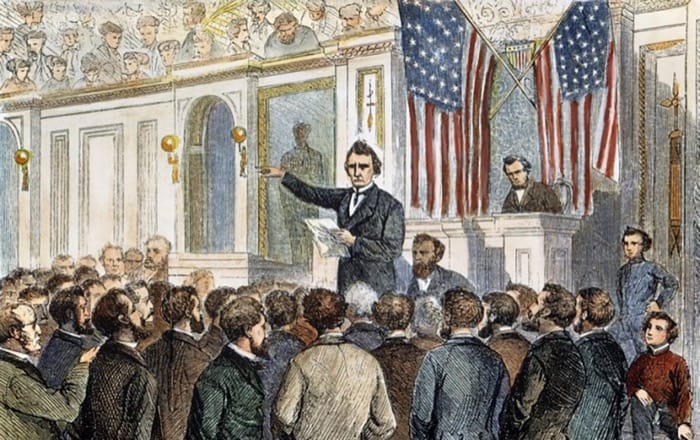
The House Committee of the Judiciary took up the question of whether to pursue articles of impeachment against President Andrew Johnson on this day, November 25, 1867 — a pivotal moment in one of the most dramatic political showdowns of the era.
At the heart of this crisis was a fierce power struggle playing out between radical Republicans in the House and President Johnson during the 40th Congress (1867 to 1869). The radicals were convinced that the President was being far too soft on the Southern states as Reconstruction unfolded in the aftermath of the Civil War.
Determined to oust a President they saw as an obstacle to their legislative agenda, the radicals launched their campaign that January. Congressman James M. Ashley of Ohio put forward a resolution calling on the Committee of the Judiciary to investigate President Johnson's conduct in office, and the House gave its approval.
After conducting hearings, however, the Committee concluded its review and voted against impeachment in June.
But the story was far from over. By November 1867, the political winds had shifted among Republicans, who grew increasingly supportive of impeachment following what they viewed as provocative actions by President Johnson. On the 25th, the Committee reversed course and voted 5 to 4 to recommend impeachment, forwarding three separate reports to the full House — one advocating for impeachment and two arguing against it.
The fight spilled into December, where the full House engaged in extensive debate before ultimately rejecting impeachment by a vote of 108 to 57.
The issue roared back to life in January and February 1868, when the House revisited impeachment proceedings. On February 24, having concluded that President Johnson had violated the Tenure of Office Act, the House voted 126 to 47 to impeach the President on the constitutional grounds of "high crimes and misdemeanors."