
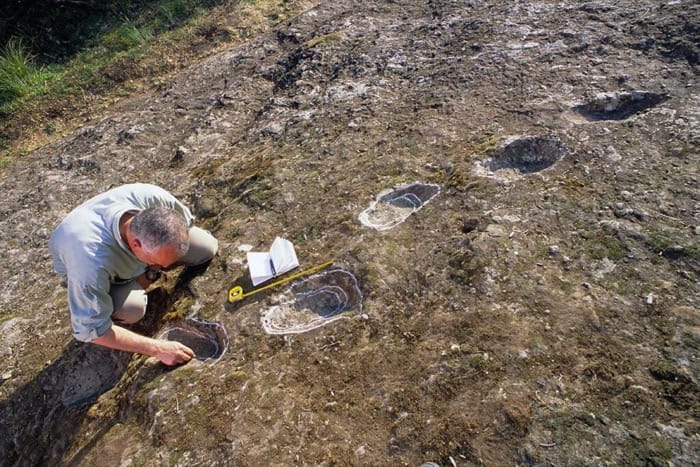
On March 13, 2003, a remarkable discovery was announced: scientists working in southern Italy had found ancient human footprints locked within layers of volcanic ash. Estimated to be 350,000 years old, these impressions hold the distinction of being the oldest ever identified from the Homo genus — the broader group to which modern humans (homo sapiens) belong. The footprints are believed to have been left by three individuals who walked upright, most likely members of the subspecies Homo heidelbergensis, a group that was widespread across Europe during the Paleolithic era or Stone Age.
The three sets of prints trail down the flanks of the Italian volcano, each telling a slightly different story. One individual apparently descended in a zig-zag pattern, while another took a more straightforward path downhill. Scattered among the footprints, scientists also identified occasional handprints — evidence that the small group braced themselves with their hands as they navigated the steep slope. Beyond those moments of steadying themselves, however, all three clearly traveled upright on two legs, moving in a manner strikingly similar to how modern humans walk today.
Discoveries like this aren't limited to Italy, of course. Some of the earliest known hominid footprints can be found in Laetoli, Tanzania, where archaeologist Mary Leakey uncovered a set of ancient tracks back in 1976. Those impressions, preserved in volcanic ash much like the Italian prints, date back an astonishing 3.75 million years. They, too, demonstrate bipedalism — the ability to walk on two feet — a trait that is uniquely human in the evolutionary record. What's particularly fascinating is that further research points to early humans having developed the capacity for upright walking before the evolution of enlarged brains, another pivotal milestone in our species' development.
There is still so much waiting to be unearthed and examined when it comes to human evolution and the lives of our ancient ancestors. Yet finds like these keep pushing the boundaries of what we know, marking genuine steps forward in humanity's anthropological understanding of itself.