
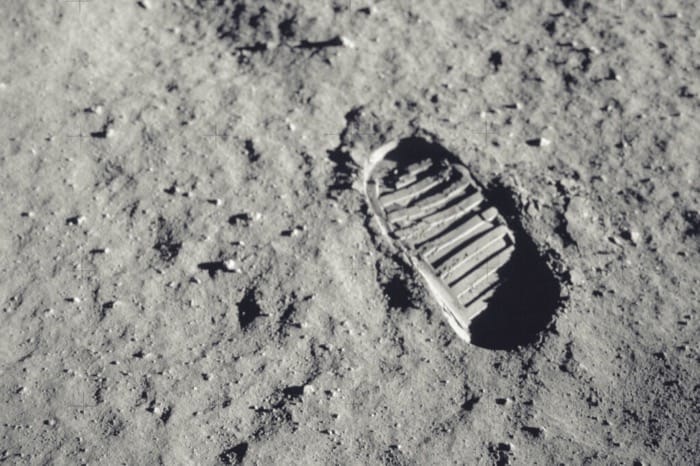
An estimated 650 million people around the globe were glued to their television sets on July 21-1969, listening as Commander Neil Armstrong delivered what would become one of history's most famous quotes: "That's one small step for man. One giant leap for mankind." With those words, he stepped onto the lunar surface and changed the course of human exploration forever.
Getting to that moment, however, wasn't entirely smooth. Armstrong struggled to make his way out of the lunar module, named Eagle. Once he finally emerged, he paused to survey the barren terrain of the Sea of Tranquility, the lunar region where they had touched down. He noted the remarkably fine, somewhat powdery nature of the Moon's dust before pressing forward to leave the first boot print ever made on its surface.
About 20 minutes later, Apollo 11's pilot Buzz Aldrin climbed out of Eagle to join him, earning the distinction of being the second human being to walk on our Moon. Together, the pair carried out a series of scientific experiments on the lunar surface — work that would prove essential in deepening humanity's understanding of the Moon.
The Apollo 11 mission was groundbreaking in every sense. Not only was it the first manned mission to reach another planetary body, but it also delivered the first extravehicular activity ever broadcasted and yielded the first geological samples gathered from the Moon. On top of all that, it featured the first telephone conversation between Earth and the Moon, with U.S. President Richard Nixon speaking to Armstrong and calling it "the most historic phone call ever made from the White House."
The mission's success was far from guaranteed, and President Nixon knew it. The prospect of announcing a costly failure — one that could claim the lives of two astronauts — to the American public was something he did not relish. His concerns were well-founded, as Apollo 11 encountered a string of problems before it managed to land safely.
Among the many issues: intermittent radio connectivity plagued communications between Apollo 11 and Earth, and a last-minute discovery revealed that the Eagle module was consuming fuel at a higher rate than initially intended, causing it to overshoot its planned landing site.
In the end, though, it was the astronauts' sharp instincts, remarkable skill, and sheer determination that carried the day — delivering what stands as one of the most significant and awe-inspiring scientific achievements of all time.