
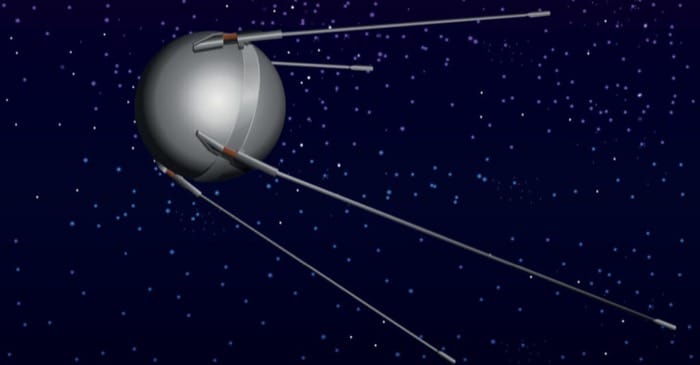
On October 4th, 1957, the Soviet Union made history by sending Sputnik I — the world's first artificial Earth satellite — hurtling into orbit around our planet.
Sputnik I
Roughly the size of a basketball and tipping the scales at a mere 183 pounds, Sputnik I followed an elliptical path around the Earth, completing each loop in about 96 minutes. The satellite itself was a metal sphere with a diameter of 58 cm (23 in). To enable tracking through radio pulse broadcasts, engineers equipped it with four external radio antennas.
America's Reaction
The U.S. Government was caught completely off guard by the launch — they hadn't anticipated such a feat for at least several more years. Ordinary American citizens were equally stunned, with some even worrying that Sputnik could be some kind of weapon. The event went out live over radio, making the announcer's voice the first human sound ever transmitted from space in recorded history.
Meanwhile, the American press stoked fears by dubbing it a "super bomb" and "Jap-buster," raising alarm that the U.S.'s Cold War enemy could now potentially drop bombs on them from space.
The Launch
Lifting off from the Baikonur Cosmodrome, the satellite rode atop a modified Intercontinental Ballistic Missile (ICBM) that had been designed by Sergei Korolev alongside his team of scientists and engineers. Once in orbit, Sputnik I raced along at about 29,000 kilometers per hour (18,000 mph), needing just 96.2 minutes to complete each revolution.
For three months, Sputnik I circled the Earth every 98.1 minutes — until its batteries gave out. It ultimately fell from orbit on January 4th, 1958, burning up as it reentered the atmosphere over the southern Indian Ocean. The triumph of Sputnik 1 marked the dawn of the space age and set off the Space Race between the United States and the Soviet Union.