
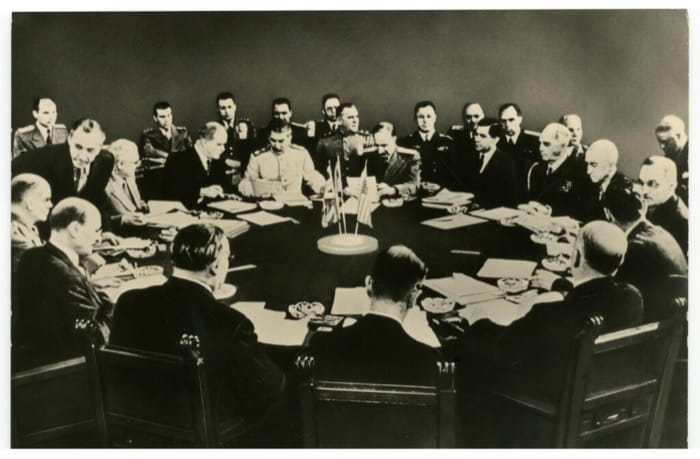
The major Allied powers didn't always see eye to eye during WW2, which made coordination a constant challenge. To address this, three landmark conferences brought together the leaders of the United States, the Soviet Union and the United Kingdom, each designed to keep the wartime partnership on track.
These gatherings took place in sequence: the Tehran Conference in November of 1943, followed by the Yalta Conference in February of 1945, and finally the Potsdam Conference in July and August of 1945.
What made the Potsdam Conference stand out was just how dramatically the landscape had shifted compared to the earlier summits.
Consider the leadership upheaval alone. President Franklin D. Roosevelt had passed away on April 12 of 1945, meaning his successor President Harry S. Truman now represented the United States at the table. On the British side, Prime Minister Winston Churchill initially attended but was replaced part-way through by Prime Minister Clement Attlee, the victor of the 1945 United Kingdom general election.
There was also the matter of timing—the conference convened after May 8, the date marking the Allied acceptance of Nazi Germany's unconditional surrender. This meant a central priority was figuring out how the Allied powers would go about administering the defeated country.
Thanks to an agreement reached during the Yalta Conference, the French had secured a role in decisions about Germany's future. Yet Charles de Gaulle, the French leader, found himself excluded from the Potsdam Conference due to American insistence. This snub would fuel considerable resentment in the period that followed.
Another thorny issue on the agenda involved the Soviet occupation of Central and Eastern Europe, which stood in sharp contrast to the promises Stalin had made at the close of the Yalta Conference.
It's no surprise, then, that the Potsdam Conference played an enormous role in shaping the postwar world order, one dominated by the United States and the Soviet Union. The conference produced agreements governing the fate of Germany, Italy, Poland and other countries.
On top of all this, the conference laid out surrender terms for Japan—though notably, the Soviet Union played no part in drafting that declaration, given that it remained neutral at that point.
Japan's leadership offered no response. This silence was taken as a rejection of the declaration, and the consequences were staggering: it opened the door for the United States to deploy their new, unspecified weapon—the first two nuclear bombs.