
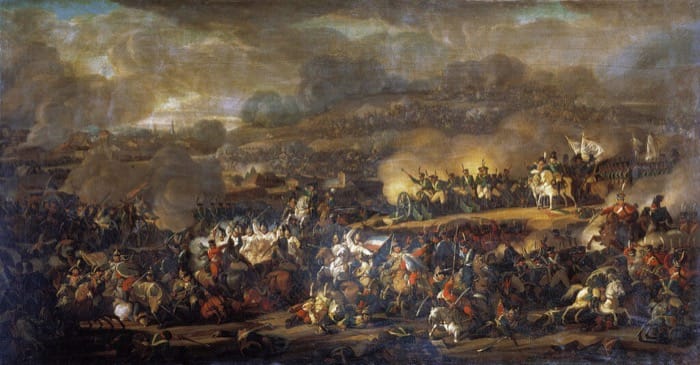
The Battle of Leipzig — widely remembered as the Battle of Nations — stands as one of the most consequential military engagements ever fought, holding the record as Europe's largest battle until the First World War shattered all previous scales. Serving as a turning point in the Napoleonic Wars, this massive confrontation drew in five armies and close to half a million soldiers. Taking place between October 16 and October 19, 1813, the clash dealt Napoleon a crushing defeat, effectively dismantling what remained of French dominance across Germany and Poland.
The fighting unfolded outside the city of Leipzig in Saxony, where Napoleon commanded a combined force of 185,000 French, Saxon, and other allied German troops. Opposing him stood a coalition army numbering 350,000, drawn from Prussia, Austria, Sweden, and Russia, all operating under the overall control of Schwarzenberg. Napoleon's strategy hinged on seizing Leipzig's position to split his enemies apart and strike them individually. During the opening day of combat, the French came tantalizingly close to victory as the Prussian Army joined the fray, while the Army from the North — a Russo-Prusso-Swedish force under Bernadotte — held back and refused to fully commit. Yet Napoleon fell prey to a familiar weakness: his repeated shifts in operational focus throughout the campaign ultimately undermined his efforts.
The second day saw Napoleon devote the bulk of his time to repositioning his forces, even as allied strength swelled dramatically. Making matters worse, his Saxon troops abandoned him entirely. By the battle's final day, the coalition's overwhelming numbers and growing combat power had become simply too much for Napoleon and his men to withstand.
With the arrival of Russian and Swedish troops, fierce combat raged for a grueling nine hours stretching until midnight, at which point Napoleon gave the order to pull back. Initially, the retreat proceeded in an orderly manner, maintaining discipline until the early afternoon of October 19, 1813. The Battle of Leipzig holds a unique distinction as the first occasion on which Napoleon suffered defeat on the battlefield. In the aftermath, the French Grande Armee continued its westward withdrawal as an ever-growing number of German princes abandoned Napoleon's cause, a cascade of defections that culminated in his abdication in 1814.