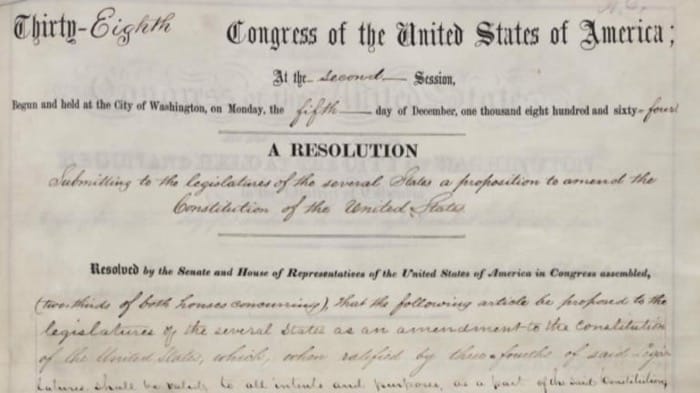
On January 13, 1865, the 13th Amendment to the Constitution cleared the United States Congress, officially bringing an end to the institution of slavery. Beyond abolishing slavery, the amendment also prohibited involuntary servitude — with one notable exception: as a form of criminal punishment.
When the amendment passed, twenty-seven of the then thirty-six states in the union moved to ratify it, establishing the necessary majority. This ratification process concluded on December 6, 1865, followed by a formal proclamation just under two weeks later on December 18th. Historically, the 13th Amendment holds the distinction of being the first among the Reconstruction Amendments enacted in the wake of the Civil War.
Before Congress took this landmark step, President Abraham Lincoln had already acted through executive authority. On September 22, 1862, he issued what became known as the Emancipation Proclamation — a presidential decree that declared all enslaved individuals in Confederate states to be free as of January 1, 1863.
Yet even with this executive order in place, the reality on the ground told a far different story. Enslaved Americans were neither immediately nor uniformly liberated from the brutalities of slavery and involuntary servitude. The truth is that many people remained in bondage well past both the conclusion of the Civil War and the passage of the 13th Amendment itself. This was especially prevalent in Confederate states, where enslaved people were deliberately kept unaware of their own freedom.
It's also worth noting that the amendment left a significant loophole: slavery was abolished except as punishment for crime. This particular carve-out has largely escaped scrutiny in mainstream public conversation. That said, the profound consequences of this exception — both for the nation at large and for Black Americans specifically — have increasingly become a subject of broader examination, dialogue, and action.
One compelling illustration of this growing awareness is "13th," a pioneering documentary created by award-winning director Ava DuVernay.